

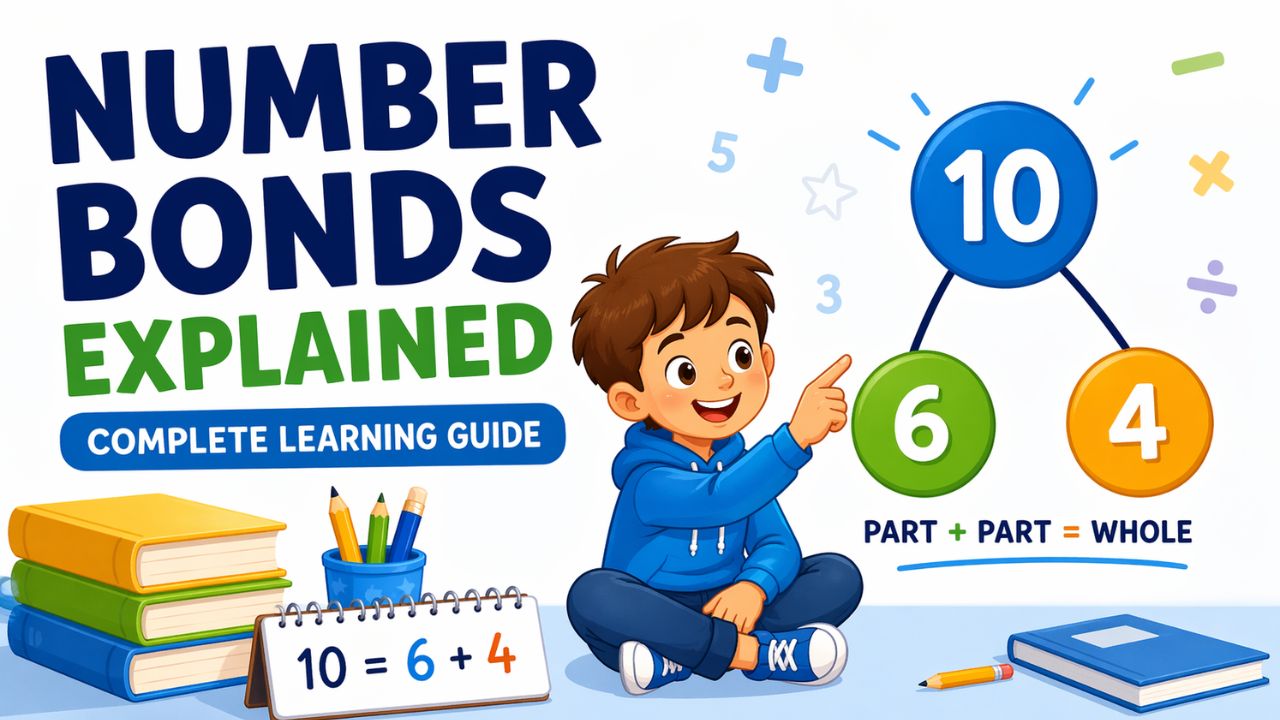
If your child is struggling to add up quickly, or their teacher has mentioned “number bonds” in their report, you’re in the right place.
Number bonds are one of the first big maths skills children learn at school — and one of the most important. Once a child truly understands number bonds, everything from addition and subtraction to mental maths and times tables becomes much easier.
In this guide, you’ll find a clear explanation of what number bonds are, step-by-step lessons, tricks to help children remember them, common mistakes to avoid, and plenty of practice questions. You can also reinforce every skill using Hit the Button — our free interactive maths game that builds speed and confidence in just a few minutes a day.
Whether you’re a parent helping at home, a teacher looking for fresh ideas, or a child working through KS1 or KS2 maths, this guide has everything you need.
What Are Number Bonds?
A number bond is a pair of numbers that add together to make a total. Simple as that.
For example, the number bonds to 10 are:
- 1 + 9 = 10
- 2 + 8 = 10
- 3 + 7 = 10
- 4 + 6 = 10
- 5 + 5 = 10
- 0 + 10 = 10
Each pair is a “bond” — two numbers joined together to make one whole number.
Children learn number bonds for several totals: 5, 10, 20, and later 100. The goal is to know these pairs instantly, without counting on fingers.
Think of it like learning the alphabet. Once you know it, you don’t think about it — you just use it. Number bonds work the same way.
Why Number Bonds Matter (KS1 and KS2)
Number bonds might seem simple, but they’re the foundation of almost everything in primary maths.
In school (KS1 – Year 1 and 2): The National Curriculum requires children to know number bonds to 10 and 20 by the end of Year 1, and bonds to 100 by Year 2. Teachers use them to introduce addition, subtraction, and place value.
In everyday life:
- Working out change at a shop
- Splitting food or items between people
- Quick mental calculations
Cognitive benefits:
- Builds working memory (holding numbers in mind while solving problems)
- Improves maths fluency and speed
- Boosts confidence — children who know their number bonds feel less anxious in class
Research in maths education consistently shows that children who automatise number bonds early perform better in later maths topics, including multiplication, fractions, and algebra.
Step-by-Step Guide to Learning Number Bonds
Step 1: Start with Number Bonds to 5
Before jumping to 10, help young children build confidence with smaller numbers.
Explanation: How many ways can you make 5?
Examples:
- 0 + 5 = 5
- 1 + 4 = 5
- 2 + 3 = 5
Mini tip: Use five fingers. Hold up 2 fingers on one hand, then ask, “How many more do I need to make 5?” Children can physically see the answer.
Step 2: Learn Number Bonds to 10
This is the big one for KS1. Number bonds to 10 are used constantly in mental maths.
Explanation: There are 11 pairs that make 10 (including 0 + 10).
Example: Imagine a ten-frame (a grid with 10 boxes). Fill in 3 boxes — how many are empty? That’s 7. So 3 + 7 = 10.
Mini tip: Teach the “turn-around” rule early. If 3 + 7 = 10, then 7 + 3 = 10 too. This halves the memory load.
Step 3: Extend to Number Bonds to 20
Once children are confident with bonds to 10, bonds to 20 follow naturally.
Explanation: Use what they already know and extend it.
Example:
- They know 6 + 4 = 10
- So 16 + 4 = 20 works the same way
Mini tip: Point out the pattern. The units digit stays the same — only the tens change. This is a lightbulb moment for many children.
Step 4: Bonds to 100
By Year 2, children extend bonds to multiples of 10 up to 100.
Explanation: Which two multiples of 10 add to 100?
Examples:
- 30 + 70 = 100
- 60 + 40 = 100
- 25 + 75 = 100
Mini tip: Use money. “If I have 60p, how much more do I need to make £1?” Real-life context makes this click instantly.
Easy Tricks and Shortcuts for Number Bonds
The Mirror Trick Every number bond has a mirror. 3 + 7 = 10 and 7 + 3 = 10. Once you know one, you know both. This doubles recall efficiency.
The Subtraction Link Number bonds also unlock subtraction. If 6 + 4 = 10, then 10 − 4 = 6 and 10 − 6 = 4. Same bond, three facts. Always show children this connection.
Colour Coding Write each bond pair in matching colours. 3 is red, 7 is red — because they go together. Visual memory is powerful.
Rainbow Bonds Draw an arc (like a rainbow) from 1 to 9, 2 to 8, 3 to 7, and so on, with 10 at the top. Children love drawing these and it makes the pattern visual and memorable.
The 5-and-Some-More Method Split numbers around 5. To make 8: 5 + 3. To make 9: 5 + 4. This builds mental flexibility and links to bonds to 5.
Common Mistakes — and How to Fix Them
1. Counting on fingers for every answer Why it happens: The bonds haven’t been memorised yet — children are still calculating. Fix: Drill bonds to 10 daily for 2–3 minutes with flashcards or a fast game like Hit the Button maths. Repetition builds automatic recall.
2. Forgetting that 0 is a bond partner Why it happens: Children don’t think of 0 as a “real” number in context. Fix: Explicitly include 0 + 10 = 10 in every list you teach.
3. Confusing bonds to 10 with bonds to 20 Why it happens: The patterns look similar and children mix up the tens digit. Fix: Colour code them separately. Bonds to 10 in blue, bonds to 20 in green.
4. Not seeing the subtraction link Why it happens: Addition and subtraction are taught separately at first. Fix: Always show the “fact family” together: 3 + 7 = 10, 7 + 3 = 10, 10 − 3 = 7, 10 − 7 = 3.
5. Giving up when speed is tested Why it happens: Timed tests create anxiety before fluency is built. Fix: Start with untimed practice. Build speed gradually using a game format like Hit the Button, where pressure is playful rather than stressful.
6. Skipping straight to bonds to 100 Why it happens: Parents or teachers rush ahead because children seem ready. Fix: Check bonds to 10 are truly automatic first. 100% fluency at one level before moving up.
7. Learning bonds in order only (1+9, 2+8…) Why it happens: Worksheets usually list bonds in order. Fix: Practise in random order. Real mental maths doesn’t come in sequence.
Fun Ways to Practise Number Bonds
At Home:
- Bond Snap: Make a simple card set with numbers 0–10. Flip two cards — shout “Snap!” if they bond to 10.
- Number Bond Hopscotch: Write numbers on pavement squares. Call out a number — child hops to its bond partner.
- Kitchen Maths: “We need 10 strawberries. I’ve put in 4. How many more?”
In the Classroom:
- Bond Relay: Teams race to fill in missing bond partners on a whiteboard.
- Human Number Bonds: Give each child a number card. Shout a total — children with matching bonds hold hands.
- Ten-Frame Bingo: Fill a ten-frame and call out the missing partner.
Real-Life Applications:
- Counting change
- Sharing snacks equally
- Scoring in simple games
🎮 Practise Number Bonds with Hit the Button
One of the best ways to turn number bond knowledge into automatic recall is through fast, repeated practice — and that’s exactly what Hit the Button is designed for.
Hit the Button is an interactive maths game where answers appear on screen and children tap the correct one as quickly as possible. It’s designed for speed, accuracy, and building genuine confidence.
Here’s why it works so well for number bonds:
Speed: The game trains children to recall bonds instantly rather than working them out. That split-second recognition is exactly what mental maths requires.
Accuracy: Each wrong answer is tracked, so children learn from mistakes rather than repeating them.
Confidence: Because it’s a game, children don’t feel the pressure of a test. They want to beat their own score, which means they practise again and again — willingly.
Modes available on Hit the Button include:
- Number bonds to 10
- Number bonds to 20
- Number bonds to 100
- Halves, doubles, times tables, and division facts
Try setting a 2-minute Hit the Button session before homework each evening. Within two weeks, most children show noticeable improvement in both speed and confidence.
The hit the button maths game is completely free and works on tablets, smartphones, and computers — perfect for home or classroom use.
Practice Questions
Try these yourself — answers are below!
Number Bonds to 10:
- 6 + __ = 10
- __ + 3 = 10
- 10 − 8 = __
- What two numbers bond to 10 if one of them is 5?
Number Bonds to 20: 5. 13 + __ = 20 6. __ + 6 = 20 7. 20 − 15 = __
Number Bonds to 100: 8. 40 + __ = 100 9. __ + 55 = 100 10. 100 − 30 = __
Mixed Challenge: 11. If 7 + 3 = 10, what is 70 + __ = 100? 12. True or false: 8 + 3 is a number bond to 10.
Answers:
- 4 | 2. 7 | 3. 2 | 4. 5 + 5 | 5. 7 | 6. 14 | 7. 5 | 8. 60 | 9. 45 | 10. 70 | 11. 30 | 12. False (8 + 3 = 11)
Expert Tips for Parents and Teachers
For Parents:
- Little and often beats long sessions. Five minutes of number bond practice daily is more effective than one 30-minute session a week. Consistency builds automatic recall.
- Praise effort over speed. Tell children “You’re getting faster every day” rather than “Why don’t you know this yet?” Confidence matters.
- Make it competitive — gently. “Can you beat your time from yesterday?” is more motivating than “Do this worksheet.” The Hit the Button game uses this instinct brilliantly.
- Use bath time, car journeys, and mealtimes. “Quick — what goes with 7 to make 10?” These micro-practice moments add up enormously.
For Teachers:
- Start every maths lesson with a 2-minute bond blast. Oral, fast-paced, whole-class. No writing — just quick-fire questions.
- Show fact families explicitly. Don’t teach addition bonds and subtraction separately. Show all four related facts every time.
- Use formative assessment to identify gaps. If a child knows 2 + 8 instantly but hesitates on 8 + 2, they haven’t truly internalised commutativity. Address it directly.
- Celebrate milestones. A “Number Bond Champion” board (for bonds to 10 mastered, bonds to 20 mastered, etc.) gives children visible goals.
Advanced Insight: Why Automaticity Changes Everything
There’s a reason teachers talk about children “knowing” number bonds rather than being able to “work them out.
In cognitive psychology, this is called automaticity — the ability to perform a task without conscious effort. When number bonds are automatic, working memory is freed up for harder problems.
Here’s what this means in practice:
When a child is solving 47 + 13, they need to:
- Recognise that 7 + 3 = 10 (bond to 10)
- Carry the 10 into the tens column
- Add 4 + 1 + 1 = 6
If the child has to think about 7 + 3, their working memory fills up and the rest of the problem falls apart. But if 7 + 3 = 10 is instant — automatic — they can focus entirely on the carrying step.
This is why number bonds are taught before column addition, before times tables, and before fractions. They are the cognitive scaffolding for all of primary maths.
Automaticity is built through spaced repetition — short practice sessions spread over time. This is exactly the principle behind the press the button maths game format, where children revisit the same facts across multiple short sessions rather than one long drill.
Frequently Asked Questions
What are number bonds in maths? Number bonds are pairs of numbers that add together to make a specific total. For example, 3 and 7 are number bonds to 10 because 3 + 7 = 10.
When do children learn number bonds in the UK? Children begin learning number bonds to 5 and 10 in Year 1 (age 5–6), extend to bonds to 20 in Year 1–2, and learn bonds to 100 by Year 2 (age 6–7), in line with the KS1 National Curriculum.
How does Hit the Button help with number bonds? The hit the button maths game builds automatic recall through fast, repeated practice. Children tap the correct answer against the clock, which trains the brain to retrieve bonds instantly rather than calculating them slowly.
What’s the difference between number bonds to 10 and number bonds to 20? Bonds to 10 are pairs that total exactly 10 (e.g., 4 + 6). Bonds to 20 are pairs that total 20 (e.g., 14 + 6 or 13 + 7). Many bonds to 20 use the same units digits as bonds to 10, just with a 10 added on.
How long does it take to learn number bonds? With daily 5-minute practice, most children can recall bonds to 10 automatically within 4–6 weeks. Bonds to 20 typically take another 3–4 weeks after that.
Can number bonds help with times tables too? Yes — the skills overlap. Strong number bonds build mental arithmetic confidence and pattern recognition, both of which make learning times tables easier. You can also practise times tables and doubling and halving on Hit the Button once bonds are secure.
What if my child keeps forgetting their number bonds? Don’t worry — this is normal. The key is regular, short practice rather than occasional long sessions. Try the push the button maths game format: two minutes each day, mix up the order, and always celebrate progress rather than perfection.
Conclusion: Build the Foundation, Watch the Confidence Grow
Number bonds aren’t just a maths topic — they’re the foundation everything else is built on.
When children know their bonds automatically, they stop dreading mental maths and start enjoying it. Sums that once took them a minute now take seconds. Harder topics like column addition, subtraction, multiplication, and fractions all become more manageable.
The key takeaways from this guide:
- Start with bonds to 5, then 10, then 20, then 100
- Always teach the fact family (addition and subtraction together)
- Use the mirror trick and rainbow bonds for memory
- Practise in short, daily sessions — not long, infrequent ones
- Use the Hit the Button game to build genuine speed and confidence
Whether you’re a parent sitting at the kitchen table or a teacher planning your next lesson, the most important thing is consistency. A little practice every day adds up to something remarkable.
Ready to start? Head to the Hit the Button maths game and pick “Number Bonds to 10” — then watch your child’s confidence grow with every tap.