

The Fastest Way to Build Maths Confidence in Young Children
If your child freezes when asked “What goes with 7 to make 10?” — you’re in the right place.
Number bonds to 10 are one of the most important building blocks in early maths. Once a child truly knows them (not just recites them), everything else — addition, subtraction, mental maths, even multiplication — becomes easier and faster.
In this guide, you’ll find a clear, step-by-step explanation of number bonds to 10, practical activities, common mistakes to avoid, and a fun way to practise using our Hit the Button game. Whether you’re a parent helping at home, a teacher looking for fresh ideas, or a child ready to learn, this article has everything you need.
By the end, your child will not just understand number bonds — they’ll feel confident using them.
What Are Number Bonds to 10?
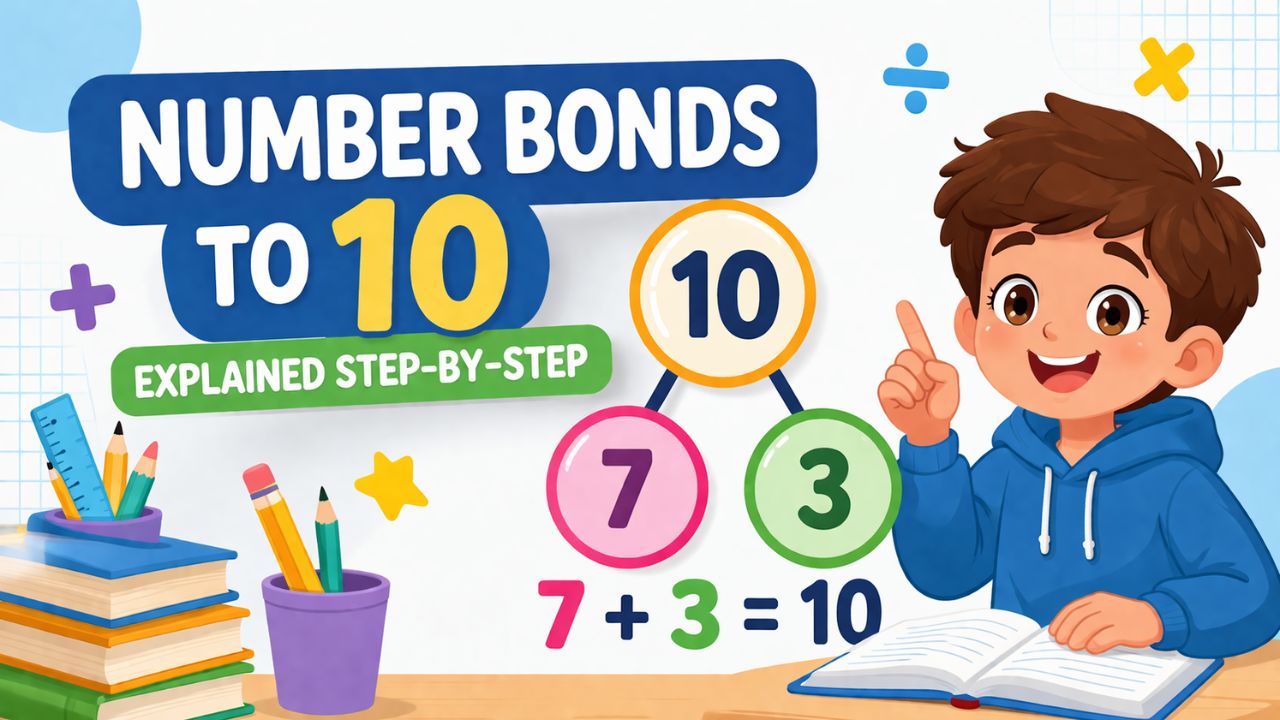
A number bond is a pair of numbers that add together to make a target number — in this case, 10.
Think of it like a friendship between two numbers. Each number has a special partner that, when added together, always makes 10.
Here are all the number bonds to 10:
| Number | + | Partner | = | Total |
|---|---|---|---|---|
| 0 | + | 10 | = | 10 |
| 1 | + | 9 | = | 10 |
| 2 | + | 8 | = | 10 |
| 3 | + | 7 | = | 10 |
| 4 | + | 6 | = | 10 |
| 5 | + | 5 | = | 10 |
| 6 | + | 4 | = | 10 |
| 7 | + | 3 | = | 10 |
| 8 | + | 2 | = | 10 |
| 9 | + | 1 | = | 10 |
| 10 | + | 0 | = | 10 |
Notice something? The pairs just flip! Once a child knows 3 + 7 = 10, they automatically know 7 + 3 = 10. That cuts the learning in half.
Why Number Bonds to 10 Matter So Much
In School (KS1 & KS2)
Number bonds to 10 are introduced in Year 1 as part of the National Curriculum and are expected to be automatic by the end of KS1. They underpin:
- Adding and subtracting within 20
- Understanding place value (tens and units)
- Mental maths strategies in KS2
- Faster times tables recall
- Working with money and measures
Children who don’t know their number bonds tend to slow down — or get stuck entirely — when maths gets harder in Year 3 and beyond.
In Real Life
Number bonds appear constantly:
- Shopping: “I have £10. I spent £6. How much change do I get?”
- Time: “It’s 7 o’clock. How many hours until 10?”
- Games and sports: Keeping score mentally
For the Brain
Research in early childhood maths education consistently shows that automatic recall (knowing without having to work it out) frees up working memory. When a child doesn’t have to think about 4 + 6, their brain has more space to tackle harder problems.
It’s the maths equivalent of learning to ride a bike — once it’s automatic, you don’t think about balancing. You just ride.
Step-by-Step Guide to Learning Number Bonds to 10
Step 1: Start With Physical Objects
Before pen and paper, use things you can touch.
How to do it: Give your child 10 small objects — buttons, coins, grapes, anything. Ask them to split them into two groups. Count each group. Write it down.
Example: 10 buttons → 4 in one hand, 6 in the other → 4 + 6 = 10 ✓
Mini tip: Do this multiple times with different splits. Let the child discover the pairs themselves rather than telling them.
Step 2: Use a Ten Frame
A ten frame is a simple 2×5 grid. Fill some squares with dots or counters — the rest stay empty. The child counts the filled dots and the empty spaces to find the bond.
Example: Fill 7 squares → 3 are empty → 7 + 3 = 10 ✓
Mini tip: Draw your own ten frame on paper in under 30 seconds. You don’t need to buy anything.
Step 3: Connect Addition to Subtraction
Once a child knows 6 + 4 = 10, show them what that means for subtraction:
- 10 − 4 = 6
- 10 − 6 = 4
Example: “If I have 10 grapes and eat 4, how many are left?” → They know the bond, so the answer comes immediately.
Mini tip: Write the “number bond family” together: 6 + 4 = 10 | 4 + 6 = 10 | 10 − 4 = 6 | 10 − 6 = 4. Four facts for the price of one.
Step 4: Move to Mental Recall (Speed Practice)
Once the concept is understood, the goal is speed. Flash cards, verbal quizzes, or interactive games work well here.
Example: Say “3!” and the child shouts back “7!” without hesitating.
Mini tip: Keep sessions short — 2 to 3 minutes of fast-fire practice beats 20 minutes of slow worksheet work every time.
Easy Tricks and Shortcuts
The Mirror Trick Number bonds to 10 are symmetrical. If your child knows the first half (0+10 through 5+5), they already know the second half flipped. Point this out — it’s genuinely exciting for children when they see it.
The “Count Up from 5” Trick For bonds involving numbers above 5, count up from 5:
- 6 needs? Count 1 more from 5… that’s 4. So 6 + 4 = 10.
- 8 needs? Count 3 more from 5… that’s 2. So 8 + 2 = 10.
The Hand Method Hold up both hands — 10 fingers. Fold down 3 fingers. Count the ones still up: 7. So 3 + 7 = 10. Simple, physical, and always available.
Anchor on 5 5 + 5 is the middle bond. Everything else is just moving away from the middle. Knowing this helps children see the pattern rather than memorise a list.
Common Mistakes Children Make (And How to Fix Them)
Mistake 1: Counting on fingers for every answer Why it happens: The bonds aren’t automatic yet. Fix: More speed practice. Games and flashcards help here more than worksheets.
Mistake 2: Forgetting that subtraction uses bonds too Why it happens: Addition and subtraction feel like separate topics. Fix: Always teach the full “bond family” of four facts together.
Mistake 3: Confusing number bonds to 10 with bonds to 20 Why it happens: They look similar, and children mix them up when moving to Year 2. Fix: Use colour coding — bonds to 10 in blue, bonds to 20 in red.
Mistake 4: Skipping 0 and 10 Why it happens: Children don’t think 0 + 10 “counts.” Fix: Explain that 0 is a real number with real jobs. Practise it intentionally.
Mistake 5: Rushing to written methods too early Why it happens: Workbooks often jump to written sums before the concept is solid. Fix: Keep physical and verbal practice going even after written work begins.
Mistake 6: Knowing bonds but not recognising them in word problems Why it happens: The link between abstract numbers and word problems isn’t made. Fix: Use story contexts. “There are 10 birds. 8 fly away. How many are left?” regularly.
Mistake 7: Inconsistent practice Why it happens: Maths practice at home is often irregular. Fix: Little and often. Even 3 minutes daily builds stronger recall than one long session a week.
Fun Practice Methods That Actually Work
At Home
- Bath time counting: Use plastic cups or toys — split 10 objects into two groups
- Snack maths: “You have 10 raisins — eat 3. How many are left? What bond is that?”
- Number bond snap: Write bonds on index cards and play pairs
- Staircase game: Write bonds on steps drawn on paper — hop a toy up the stairs
In the Classroom
- Ten frame whiteboard activity: Teacher fills a ten frame on the board, children write the bond on mini whiteboards
- Number bond relay: Split class into two teams — call a number, first child to shout the partner wins a point
- Bond of the Day: Feature one bond every morning in your starter activity
Real-Life Applications
- Give children exact change scenarios: “You have 10p. The sticker costs 7p. How much change?”
- Use a dartboard or score sheet — “You need 10 points. You have 6. How many more?”
- Cooking: Measuring with a scale, counting to 10
Practise This Skill Using Hit the Button
One of the best ways to build real speed and confidence with number bonds is by playing Hit the Button — the interactive maths game used by thousands of children and teachers across the UK.
Here’s why it works so well:
Speed under pressure Hit the Button presents questions in a timed format. This trains the brain to recall bonds automatically — exactly the kind of fluency the National Curriculum expects.
Immediate feedback Children find out instantly if they’re right. That immediate response is far more effective than finding out a day later from a marked worksheet.
Builds genuine confidence Each correct answer triggers a positive response. Children want to beat their own score. That self-motivation is incredibly powerful for reluctant learners.
Flexible practice You can select number bonds to 10 specifically, meaning practice is targeted and focused. No wasted time on unrelated topics.
Works on any device Whether you’re on a school computer, tablet, or phone at home — Hit the Button maths is ready whenever your child is.
How to get the most from it:
- Start slow — let the child read and answer without pressure at first
- Play 2–3 rounds focusing only on number bonds to 10
- Note the score and try to beat it next session
- Gradually increase the challenge to number bonds to 20 once 10 is solid
Hit the Button is fully aligned with the KS1 and KS2 maths curriculum. It’s used by teachers in classrooms precisely because it builds the mental fluency that written practice alone can’t deliver.
You can also use the game to practise times tables, number bonds to 20, halving and doubling, and more — making it a one-stop tool for primary maths fluency.
Practice Questions
Try these yourself! Answers are below.
Section A — Fill in the Missing Number
- 3 + ___ = 10
- ___ + 8 = 10
- 5 + ___ = 10
- ___ + 1 = 10
- 6 + ___ = 10
Section B — Subtraction Using Bonds
- 10 − 7 = ___
- 10 − ___ = 4
- 10 − 2 = ___
Section C — Word Problems
- There are 10 children in the playground. 6 go inside. How many are still outside?
- A bag has 10 sweets. Tom eats some and 3 are left. How many did Tom eat?
- Mia scores 10 points in a game. She gets 5 in the first round. How many does she get in the second round?
- A jar holds 10 marbles. There are 9 in the jar. How many are missing?
Answers:
- 7 | 2. 2 | 3. 5 | 4. 9 | 5. 4 | 6. 3 | 7. 6 | 8. 8 | 9. 4 | 10. 7 | 11. 5 | 12. 1
Expert Tips for Parents and Teachers
For Parents:
- Don’t drill under stress. Keep practice playful, especially for children aged 5–7.
- Celebrate automatic recall when it happens — “You just knew that! That’s brilliant.”
- Link new skills to bonds. When your child learns to add 17 + 3, point out it uses the same 7 + 3 = 10 bond they already know.
- Use the car, dinner table, and bath time. Maths doesn’t need to happen at a desk.
For Teachers:
- Use bonds to 10 as a daily starter right through KS2, not just KS1 — retrieval practice strengthens long-term memory.
- Differentiate using the Hit the Button game — lower-attaining children practise bonds to 10 while others move to bonds to 20 or 100.
- Connect bonds explicitly to column addition. When children see carrying and regrouping, remind them it’s just the number bonds they already know.
- Track fluency, not just accuracy. A child who gets 10/10 slowly needs different support than a child getting 10/10 quickly.
Advanced Insight: Why Automaticity Changes Everything
There’s a concept in cognitive science called cognitive load — the amount of mental effort the brain is using at any one time. When a task uses up a lot of cognitive load, there’s less space available for new learning.
Number bond automaticity reduces cognitive load dramatically.
When a child has to work out that 7 + 3 = 10, they’re using up mental energy. When they just know it, that energy is freed up for the harder part of the problem — understanding what the question is asking, checking their work, or moving on to the next step.
This is why teachers often say: “Get the basics automatic, and harder maths becomes easier.” It’s not just good advice — it’s backed by how memory works.
There’s also a strong link to pattern recognition. Children who understand number bonds start seeing numerical patterns everywhere — in times tables, in fractions (5 is half of 10), in percentages (60% + 40% = 100%). Number bonds to 10 aren’t just one skill. They’re the foundation for a whole way of thinking about numbers.
Frequently Asked Questions
What age should children learn number bonds to 10? Number bonds to 10 are typically introduced in Reception (age 4–5) and expected to be automatic by the end of Year 1 (age 5–6). However, children who missed this in early years can catch up at any age with the right practice.
How is Hit the Button useful for number bonds? Hit the Button is a timed interactive game that specifically includes number bonds to 10 as a practice mode. The time pressure and instant feedback help children move from slow calculation to fast automatic recall — which is the goal.
What’s the difference between number bonds to 10 and number bonds to 20? Number bonds to 10 use pairs that add to 10 (e.g., 4 + 6). Number bonds to 20 extend this to pairs that add to 20 (e.g., 14 + 6). Children should secure bonds to 10 first before moving on.
Why does my child know the bonds but still gets questions wrong? They may know them in isolation but not recognise when to use them. Practise applying bonds in word problems and real-life contexts, not just abstract sums.
Can I use Hit the Button on a mobile phone or tablet? Yes. The Hit the Button maths game works across devices, making it easy to practise at home, in the car, or anywhere you have a few spare minutes.
How long should practice sessions be? Short and frequent beats long and occasional. Aim for 3–5 minutes daily rather than one 30-minute session per week. Even playing two rounds of Hit the Button each evening makes a measurable difference.
Are number bonds the same as addition facts? They overlap. Number bonds specifically describe the relationship between a number and its parts (e.g., 10 = 4 + 6). Addition facts is a broader term. All number bonds are addition facts, but not all addition facts are called number bonds.
Conclusion
Number bonds to 10 are small in size but enormous in impact. Master them, and the door opens to faster mental maths, stronger confidence, and a child who doesn’t dread number questions — they enjoy them.
The key takeaways:
- Number bonds to 10 are pairs that add up to 10
- They should be automatic, not calculated
- Teach with objects first, then ten frames, then speed practice
- Use the full bond family (addition and subtraction)
- Little and often is the most effective practice approach
The best next step? Head over to our Hit the Button game and try the number bonds to 10 mode right now. A few rounds a day, and you’ll be amazed at the progress within a week.
From there, you might like to explore number bonds to 20, practise times tables, or try doubling and halving — all available in the same place.
Start simple. Stay consistent. Watch the confidence grow.