

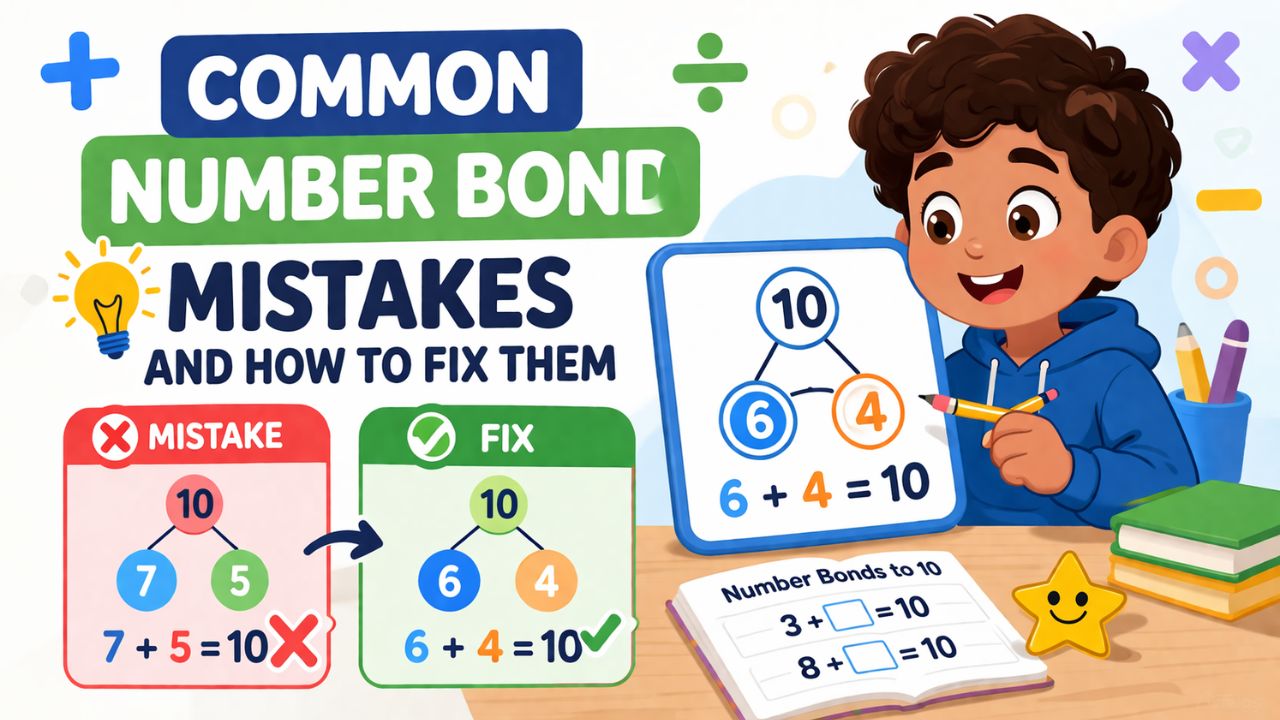
If your child freezes when asked “What goes with 7 to make 10?” — you’re not alone. Number bonds are one of the first big maths hurdles in KS1, and the mistakes children make are almost always the same ones, year after year.
This article is for parents, teachers, and anyone supporting a child aged 5–8 with early number work. By the end, you’ll know exactly which mistakes to look out for, why they happen, and — most importantly — how to fix them quickly and confidently.
We’ll also show you how tools like Hit the Button can turn slow, uncertain counting into fast, fluent recall. Whether you’re searching for hit the button maths practice or simply trying to help a child who’s struggling, this guide has everything you need.
No jargon. No waffle. Just clear, practical help from people who know KS1 maths inside out.
What Are Number Bonds?
A number bond is simply a pair of numbers that add together to make a target number.
For example:
- 3 + 7 = 10 → so 3 and 7 are a number bond to 10
- 6 + 4 = 10 → so 6 and 4 are a number bond to 10
Think of it like a fact family — two numbers that “belong together” because they always make the same total.
Children usually start with number bonds to 5 and 10 in Year 1, then move on to bonds to 20 in Year 2. These small facts become the building blocks for everything that comes later: addition, subtraction, mental maths, and even multiplication.
A child who knows their number bonds well doesn’t need to count on their fingers. They just know — instantly, reliably, confidently.
Why Number Bonds Matter More Than You Think
The KS1 and KS2 Connection
The National Curriculum expects children to recall number bonds to 10 fluently by the end of Year 1, and bonds to 20 by the end of Year 2. These aren’t optional extras — they’re formally assessed and directly linked to progress in KS2.
Without solid number bonds, children struggle with:
- Column addition and subtraction
- Mental maths strategies
- Understanding place value
- Quick recall of multiplication facts (bonds are the foundation)
The Cognitive Benefits
Knowing number bonds frees up working memory. When a child doesn’t have to calculate 8 + 2, their brain has space to focus on the harder part of a problem.
It also builds maths confidence. A child who hesitates at basic addition often switches off during lessons — not because they’re not clever, but because they’re constantly playing catch-up.
Speed and fluency come from repetition and pattern recognition. That’s exactly why tools like the Hit the Button game are so effective — they reward fast, accurate recall in a low-pressure way.
Step-by-Step: How to Teach Number Bonds Properly
Step 1: Start With Concrete Objects
Before any worksheet or screen time, children need to feel number bonds physically.
How: Use 10 counters, buttons, or small toys. Ask your child to split them into two groups. How many ways can you make 10?
Example: 6 red counters + 4 blue counters = 10. Then 5 + 5 = 10. Then 7 + 3 = 10.
Mini tip: Let the child do the splitting themselves. Hands-on discovery sticks better than being told.
Step 2: Introduce the Number Bond “Rainbow”
Once children can do it with objects, show them the visual pattern.
Draw a arc (like a rainbow) connecting each pair:
- 0 — 10
- 1 — 9
- 2 — 8
- 3 — 7
- 4 — 6
- 5 — 5
Example: “If I know 3 + 7 = 10, what’s 7 + 3?” Most children are surprised — and then delighted — that it’s the same answer.
Mini tip: This is a great moment to introduce the commutative law without using that phrase. Just say, “The numbers can swap around — the answer stays the same.”
Step 3: Move to Abstract Recall (Timed Practice)
Once the pattern is understood, it’s time to build speed. This is where hit the button maths practice becomes genuinely powerful.
How: Call out a number and ask for its “partner to 10.” Start slow, then gradually speed up over days and weeks.
Example: You say “6” — child says “4.” You say “9” — child says “1.”
Mini tip: Keep sessions short — 3 to 5 minutes is plenty. Frequency beats length every time.
Easy Tricks and Shortcuts for Number Bonds
These memory techniques genuinely help children lock in the facts:
The “10 Frame” Trick Draw two rows of five boxes. Fill some in. Children can see at a glance how many are empty — that’s the missing bond partner.
The Mirror Trick “If you know 4 + 6, you already know 6 + 4.” Halve your memorisation work instantly.
Bonds to 10 Song Set the bonds to a simple tune. “Zero and ten, one and nine, two and eight, feeling fine…” Silly rhymes stick.
Pattern Spotting Notice how as one number goes up by 1, the other goes down by 1. Children who spot this pattern stop needing to memorise — they can derive the answer.
Speed Drills with the Hit the Button Game The hit the button times tables and number bond modes give children a race-against-the-clock experience that makes fast recall feel like a game, not a chore.
Common Number Bond Mistakes and How to Fix Them
This is the heart of it. Here are the seven mistakes that come up again and again — and exactly how to address each one.
Mistake 1: Counting On From 1 Every Time
What it looks like: Child is asked 7 + ? = 10. They count “1, 2, 3, 4, 5, 6, 7” on their fingers, then count on “8, 9, 10” to find 3.
Why it happens: The child hasn’t moved beyond the counting stage. They haven’t been given enough repetition or visual support to recall the fact automatically.
The Fix: Use a 10-frame daily. Show the complete frame, cover part of it, and ask “How many are hiding?” Gradually, the child sees the answer without counting. Pair with short hit the button maths sessions for recall practice.
Mistake 2: Confusing Addition and Subtraction Bonds
What it looks like: Child knows 3 + 7 = 10 but can’t answer 10 − 7 = ?
Why it happens: They’ve memorised the addition fact in isolation without understanding that bonds work in both directions.
The Fix: Always teach bonds as a complete family of four facts:
- 3 + 7 = 10
- 7 + 3 = 10
- 10 − 3 = 7
- 10 − 7 = 3
Write all four together. Say all four aloud. The subtraction facts come free once children see the connection.
Mistake 3: Knowing Bonds to 10 But Not Bonds to 20
What it looks like: Instant recall for 6 + 4, but blank faces for 16 + 4 or 13 + 7.
Why it happens: Bonds to 20 are taught later and practised less. Children don’t always see that bonds to 10 extend naturally.
The Fix: Explicitly bridge the gap. “You know 6 + 4 = 10. So what’s 16 + 4?” Let them discover the pattern. Then practise bonds to 20 using the press the button maths number bond mode, which allows you to select the target number.
Mistake 4: Reversing the Numbers Under Pressure
What it looks like: Under timed conditions, a child says “8 + 4 = 10” instead of “8 + 2 = 10.”
Why it happens: Speed anxiety. When children feel rushed, they grab the first number that feels plausible.
The Fix: Slow down before speeding up. Make sure the child can answer every bond correctly at a slow pace before introducing timers. Confidence builds accuracy — accuracy builds speed. The hit the button game lets you choose untimed modes too, which is a great starting point for anxious learners.
Mistake 5: Only Knowing Bonds in One Order
What it looks like: Knows “2 + 8 = 10” immediately, but pauses or gets it wrong when asked “8 + 2.”
Why it happens: Rote learning without understanding the commutative property. The child has memorised a list, not a concept.
The Fix: Practise bonds starting from both numbers. Flashcards help here — put both versions on different cards. Over time, the child realises either order leads to the same answer.
Mistake 6: Forgetting the Zero Bonds
What it looks like: Child can reel off 1 + 9, 2 + 8… but stumbles on 0 + 10 or 10 + 0.
Why it happens: Zero feels like “nothing” — children sometimes skip it or treat it as trivial.
The Fix: Make zero bonds explicit. “If I have 10 sweets and give none away, how many do I have?” Real-life framing makes zero meaningful. Include 0 + 10 in every bond practice set — don’t let it be invisible.
Mistake 7: No Transfer to Word Problems
What it looks like: Child answers “6 + 4 = 10” correctly on a drill, but when asked “There are 10 children. 6 are playing outside. How many are inside?” — they’re stuck.
Why it happens: The child has learned the symbol pattern without understanding the meaning. Procedural knowledge without conceptual understanding.
The Fix: Use real-life stories daily. “We have 10 grapes — I eat 3, how many left?” Make the numbers mean something before drilling the abstract version. Once the concept is secure, the drills reinforce rather than replace understanding.
Fun Ways to Practise Number Bonds at Home and School
You don’t need worksheets. Here are genuinely engaging ways to build fluency:
At Home:
- Snap! with number bond cards — match pairs that make 10
- Egg box maths — use a 10-hole egg box and counters to explore bonds
- “Bond of the Day” on the fridge — change it each morning, quiz at dinner
- Baking — “We need 10 cherries. I’ve put 6 on. How many more?”
In the Classroom:
- Partner quizzes — one child calls a number, partner calls the bond
- Number bond washing line — peg pairs of numbers that make 10
- Mini whiteboards — fast recall rounds, children hold up their answer
Real-Life Maths:
- Counting change
- Laying the table (“We need 10 pieces of cutlery — 6 are forks, how many are spoons?”)
- Sports scores (“We need 10 points to win. We have 7 — how many more?”)
Practise Number Bonds Using Hit the Button
One of the most effective free tools for building number bond fluency is Hit the Button — a fast-paced, interactive maths game designed specifically for KS1 and KS2 children.
Here’s why it works so well:
Speed: The game presents questions one at a time with a countdown. Children must answer quickly, which trains the brain to retrieve facts automatically rather than calculating them slowly.
Accuracy: Every correct answer scores a point. Mistakes are recorded too — so children (and parents) can see exactly which bonds need more work.
Confidence: Because it’s a game, the pressure feels exciting rather than scary. Children want to beat their last score. That motivation drives repetition — and repetition drives fluency.
Flexibility: You can select number bonds to 5, 10, or 20. You can also switch to hit the button times tables mode, making it a fantastic all-round maths tool as children progress into KS2.
Whether you search for hit the button, push the button maths, or math play hit the button — this is the game that delivers results. Try it after every number bond lesson for just 3–5 minutes. You’ll notice the difference within a week.
Practice Questions
Try these yourself — answers are at the bottom.
Bonds to 10:
- 4 + ? = 10
- ? + 9 = 10
- 10 − 6 = ?
- 7 + ? = 10
Bonds to 20: 5. 14 + ? = 20 6. ? + 13 = 20 7. 20 − 8 = ? 8. 17 + ? = 20
Word Problems: 9. There are 10 children in a class. 3 are absent. How many are present? 10. A bag holds 20 apples. 11 are red. How many are green? 11. I have 10p. I spend 7p. How much do I have left? 12. There are 20 seats on a bus. 15 are taken. How many are empty?
Answers:
- 6 | 2. 1 | 3. 4 | 4. 3 | 5. 6 | 6. 7 | 7. 12 | 8. 3 | 9. 7 | 10. 9 | 11. 3p | 12. 5
Expert Tips for Parents and Teachers
For Parents:
- Little and often beats long sessions. Five minutes every day is worth more than thirty minutes once a week.
- Praise the process, not just the answer. “I love how you worked that out” builds resilience better than “well done, you’re so clever.”
- Don’t show frustration. If a child senses your stress about their progress, they’ll develop maths anxiety. Keep it light and playful.
- Use the hit the button game together — play it yourself and let them beat your score. Children love that.
For Teachers:
- Embed bond practice in the first 5 minutes of every maths lesson — a quick oral starter costs nothing and pays dividends.
- Use hit the button maths as a whole-class starter on the whiteboard. Set a class target and beat it together.
- Identify children still counting on fingers in Year 2 — intervene early with concrete manipulatives before abstract drill.
- Create bond “fluency check” grids — 20 questions, 1 minute — and track progress weekly. The data helps you target your support.
Advanced Insight: Why Fluency Is Not the Same as Understanding
Here’s something most articles get wrong: drilling facts and understanding concepts are different things — and children need both.
A child who can instantly recall 6 + 4 = 10 has fluency. But a child who understands why 6 + 4 = 10 — who can explain it with counters, draw it on a number line, and apply it to a word problem — has conceptual understanding.
The research is clear: fluency built on understanding is far more durable. Children who learn bonds purely by rote often “forget” over the summer. Children who understand the underlying structure retain and transfer knowledge much better.
This is why the best teaching sequence is always:
Concrete → Pictorial → Abstract
Start with objects. Move to diagrams. Then, and only then, move to symbol-level drills and games like hit the button times tables or number bond challenges.
When the conceptual foundation is strong, the fluency practice (drills, games, timers) locks it in for good. One without the other is less than half as effective.
Frequently Asked Questions
What is Hit the Button? Hit the Button is a free, interactive maths game popular in UK primary schools. It tests number bonds, times tables, doubling, halving, and division facts in a timed format. Search hit the button maths to find it easily online.
What age is Hit the Button suitable for? It works well for children aged 5–11 — KS1 for number bonds and doubling, KS2 for times tables and division. The difficulty levels are clearly labelled so you can match it to your child’s stage.
How long should my child practise number bonds each day? Three to five minutes of focused daily practice is ideal for most children. Consistency matters more than duration. Short, regular sessions build automaticity much faster than occasional long ones.
My child knows their bonds but still counts on fingers — why? Knowing and automatically retrieving are two different things. If a child still counts on fingers, they haven’t reached fluency yet — they’re still calculating. More repeated practice, especially timed practice with the hit the button game, helps bridge this gap.
Are number bonds the same as addition facts? Not quite. Number bonds specifically refer to pairs that make a target number (like 10 or 20). Addition facts are broader. Number bonds are a subset — but a critically important one because they’re the first facts children are expected to recall automatically.
What comes after number bonds? Once bonds to 10 and 20 are secure, children move on to addition and subtraction within 100, then to times tables in KS2. You can practise both using the hit the button times tables mode when your child is ready.
Is the Hit the Button game free? Yes — it’s free to use online with no subscription required, making it accessible for home and classroom use alike.
Conclusion: Small Mistakes, Big Fixes
Number bond mistakes are normal — every child makes them. The important thing is spotting them early and using the right strategies to fix them before they become habits.
Whether it’s counting on fingers, confusing the direction of bonds, or freezing under pressure, each mistake has a clear, proven fix. Start with concrete objects, build understanding through pictures and patterns, then layer on fluency practice using games like Hit the Button.
The children who thrive at maths aren’t necessarily the cleverest. They’re the ones who’ve practised the foundations often enough that the basics become effortless — leaving their brains free to tackle the exciting, challenging stuff.
Keep sessions short. Keep them positive. Keep them regular.
And don’t forget — you can also explore related skills like times tables, doubling and halving, and division facts to keep building on what your child learns here.
Every bond they master is one less thing to think about later. That’s not a small win — that’s the whole game.