

If your child struggles to add up quickly, or has to count on their fingers for simple sums, number bonds are exactly where to start.
Number bonds are one of the most important foundations in primary maths — and once a child truly understands them, everything else becomes easier: addition, subtraction, mental maths, and even multiplication.
This guide is written for parents, teachers, and anyone supporting a child in KS1 or KS2. Whether you’re introducing number bonds for the first time or looking for smarter ways to practise them, you’ll find practical steps, tips, tricks, and activities here.
We’ll also show you how tools like Hit the Button — a brilliant interactive maths game — can dramatically speed up a child’s recall and build real confidence.
By the end of this article, you’ll know exactly how to teach number bonds in a way that actually sticks.
What Are Number Bonds?
A number bond is simply a pair of numbers that add together to make a target number.
For example, the number bonds to 10 are:
- 0 + 10 = 10
- 1 + 9 = 10
- 2 + 8 = 10
- 3 + 7 = 10
- 4 + 6 = 10
- 5 + 5 = 10
That’s it. Two numbers. One total. Simple — but incredibly powerful.
Think of it like this: if you know that 7 + 3 = 10, you also instantly know that 3 + 7 = 10, and that 10 − 3 = 7. One bond gives you three facts for free.
Children in KS1 typically start with number bonds to 5 and 10. By KS2, they move on to bonds to 20 and 100.
Why Number Bonds Matter (More Than Most People Realise)
Number bonds aren’t just a topic in maths — they’re a mental toolkit that children carry through their entire school life.
In school (KS1 & KS2): The National Curriculum in England expects children to recall number bonds to 10 by the end of Year 1, and bonds to 20 by the end of Year 2. Without them, children struggle with column addition, mental arithmetic, and later with fractions and percentages.
In real life: Giving change, splitting a bill, totalling a shopping basket — all of these rely on fast number sense. A child who knows their bonds handles these situations naturally.
In the brain: Research in cognitive science shows that automating basic number facts frees up working memory. When a child doesn’t have to work out 6 + 4, their brain has more capacity to tackle the harder part of a problem. It’s the same reason we learn our times tables by heart.
Speed, accuracy, and confidence in maths all trace back to this one foundational skill.
Step-by-Step Guide to Teaching Number Bonds
Step 1: Start With Concrete Objects
Before numbers on a page, children need to feel the concept.
Use 10 counters, cubes, or even small sweets. Ask the child to split them into two groups. Count each group. Write down what they find.
Example: “You’ve got 10 cubes. Put some on the left and the rest on the right. How many on each side?”
The child might put 6 on the left and 4 on the right. Say: “So 6 and 4 together make 10. That’s a number bond!”
Mini tip: Let children discover multiple combinations themselves before you list them. Discovery learning helps the bonds stick far better than copying from a board.
Step 2: Move to Visual Representations
Once children understand the idea physically, introduce visual tools.
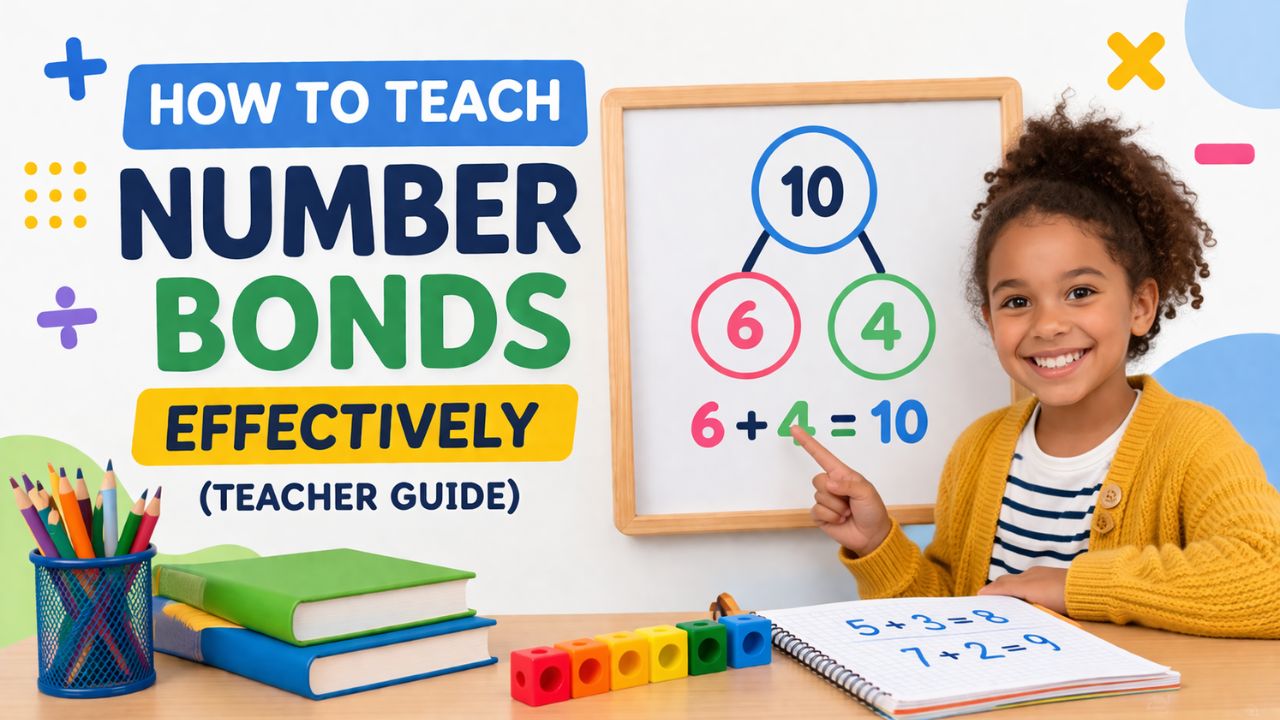
Part-whole models (also called cherry diagrams or bar models) are especially effective. Draw a circle at the top with a line splitting into two circles below. Put the total at the top, and the two parts underneath.
Example:
    10
   /  \
  7    3
This visual helps children see the relationship between the numbers, not just memorise a list.
Ten frames are equally powerful — a grid of 10 boxes where children fill in dots to show the bond. “Fill 8 boxes. How many are empty? So 8 + 2 = 10.”
Mini tip: Encourage children to draw their own part-whole models. The act of drawing reinforces understanding.
Step 3: Build to Abstract Recall
Once children understand why bonds work, they need to practise until recall is instant.
This is where speed and repetition come in — but it should still feel fun.
Flashcard drills, call-and-response games (“I say 6, you say…?”), and digital games all help here. The goal is for the child to answer without pausing to think.
Example: Teacher: “What goes with 8 to make 10?” Child (immediately): “2!”
That instant recall is the target. It won’t happen overnight — it takes regular, short bursts of practice over several weeks.
Mini tip: Five minutes a day beats thirty minutes once a week. Short, frequent practice builds automaticity far faster.
Easy Tricks and Shortcuts for Number Bonds
The “Friends of 10” Trick
Tell children that certain numbers are “best friends” — they always go together to make 10.
- 1 and 9 are friends
- 2 and 8 are friends
- 3 and 7 are friends
- 4 and 6 are friends
- 5 is friends with itself
Once children own these friendships, they stop counting and start knowing.
The Mirror Pattern
Show children that number bonds are symmetrical: 3 + 7 = 10 and 7 + 3 = 10
This halves the memorisation load. If you know one, you know the other.
The Subtraction Shortcut
Every addition bond gives you two subtraction facts automatically:
- 6 + 4 = 10 → 10 − 4 = 6 → 10 − 6 = 4
Help children see this pattern early. It means they never need to “work out” simple subtractions — they just flip the bond.
Extend to 20 and 100
Once bonds to 10 are solid, point out the pattern:
- 3 + 7 = 10, so 13 + 7 = 20, and 30 + 70 = 100
Children who spot this pattern can extend their knowledge effortlessly.
Common Mistakes and How to Fix Them
1. Jumping to abstract too soon Why it happens: Teachers and parents want to move quickly. Fix: Always spend time with physical objects and visuals before moving to numbers alone.
2. Only practising in one direction Why it happens: Children practise 2 + 8 = 10 but not 8 + 2 = 10 or 10 − 8 = 2. Fix: Always practise the full “family” of facts together.
3. Practising too infrequently Why it happens: Maths lessons are packed and daily drills feel repetitive. Fix: Build in 3–5 minutes of bond practice at the start of every maths lesson or morning routine.
4. Focusing only on bonds to 10 Why it happens: KS1 curriculum starts there and some children don’t progress further. Fix: Once bonds to 10 are fluent, explicitly teach bonds to 20 and then 100.
5. Treating wrong answers as failures Why it happens: Pressure to perform. Fix: Celebrate the attempt. Say “nearly — let’s think about it together” rather than “wrong.” Anxiety blocks memory.
6. Not connecting addition and subtraction bonds Why it happens: They’re often taught as separate topics. Fix: Explicitly show children the link: “If you know 4 + 6, you already know 10 − 4 and 10 − 6.”
7. Passive revision (just reading bonds off a chart) Why it happens: It’s easy to set up. Fix: Active recall — where the child has to produce the answer — is far more effective than passively reading a list.
Fun Practice Methods
At Home
- Bond snap: Write bond pairs on cards. Mix them up, face down. Flip two at a time — if they make 10, keep them.
- Staircase game: Count up from 0 to 10 while walking up stairs, then count down coming back. Say the bond pair at each step.
- Kitchen maths: “We need 10 grapes. You’ve already put 6 in the bowl — how many more do we need?”
In the Classroom
- Bond relay: Split the class into teams. Call out a number — first team to shout the partner wins a point.
- Exit ticket bonds: Before leaving the carpet, each child must say a bond to 10 you haven’t heard yet that session.
- Whiteboard drills: Children hold up mini whiteboards showing the missing number. Fast, visual, fun.
Real-Life Applications
- Paying with coins and counting change
- Keeping score in board games
- Working out how many minutes until break time
Real-world context makes abstract numbers feel meaningful to children.
Practise Number Bonds Using Hit the Button
One of the best tools for building fast recall is Hit the Button — an interactive maths game designed specifically for primary school children.
Here’s why it works so well:
Speed: The game puts children under gentle time pressure, which trains the brain to retrieve answers quickly — exactly what automaticity requires.
Accuracy: Instant feedback (right or wrong) means children correct mistakes immediately rather than reinforcing errors.
Confidence: Watching your score improve from session to session gives children visible proof that they’re getting better. That sense of progress is hugely motivating.
Hit the Button covers number bonds to 10, 20, and 100, as well as times tables, halves, doubles, and division facts. Children can focus on their weakest area and practise in short, focused bursts.
Whether used at school on an interactive whiteboard or at home on a tablet, Hit the Button maths turns repetitive drilling into something children want to do.
Try it for just 5 minutes a day and you’ll notice the difference within a week.
Practice Questions
Try these yourself — or use them with your child or class. Answers are at the bottom.
Bonds to 10:
- 3 + ___ = 10
- ___ + 6 = 10
- 10 − 8 = ___
- 5 + ___ = 10
Bonds to 20: 5. 13 + ___ = 20 6. ___ + 14 = 20 7. 20 − 17 = ___
Bonds to 100: 8. 40 + ___ = 100 9. ___ + 65 = 100 10. 100 − 25 = ___
Challenge: 11. If 7 + 3 = 10, what is 70 + 30? 12. A bag has 20 apples. 11 are red. How many are green?
Answers:
- 7 | 2. 4 | 3. 2 | 4. 5 | 5. 7 | 6. 6 | 7. 3 | 8. 60 | 9. 35 | 10. 75 | 11. 100 | 12. 9
Expert Tips for Parents and Teachers
For parents:
- Don’t drill bonds when a child is tired or stressed. Short, calm sessions work best.
- Use praise for effort, not just correct answers. “I love how you thought about that” beats “Well done, that’s right.”
- If your child is stuck, don’t give the answer immediately — ask “What do you already know?” This builds thinking skills alongside recall.
- Consistency matters more than duration. Five minutes every day beats an hour on a Sunday.
For teachers:
- Use number bonds as a daily warm-up, not just a topic to teach and move on from.
- Connect bonds explicitly to written addition and subtraction methods. Children should see why knowing bonds makes column addition faster.
- Differentiate: for lower-attaining pupils, stay with bonds to 10 until fluency is secure before extending. For higher attainers, explore bonds to 1000 or decimal bonds (0.3 + 0.7 = 1).
- Use assessment for learning: a quick verbal “give me a bond to 20” tells you far more than a worksheet.
- Pair children for “bond tennis” — one child serves a number, the other returns the partner. Peer learning reinforces understanding in both directions.
Advanced Insight: The Cognitive Science Behind Number Bonds
Here’s something most teaching resources don’t tell you — and it makes a real difference.
When a child first learns that 6 + 4 = 10, they use their prefrontal cortex — the problem-solving, effortful thinking part of the brain. It takes time. It takes working memory. It’s tiring.
But after enough correct repetitions, the brain shifts. The bond moves from effortful calculation into long-term memory retrieval. At that point, the answer simply appears — almost like reading a word rather than sounding it out letter by letter.
Psychologists call this automaticity, and it’s been studied extensively in relation to maths fluency. Research consistently shows that children who achieve automaticity with basic facts significantly outperform those who don’t on higher-order maths tasks — not because they’re more intelligent, but because their working memory is free to focus on the harder thinking.
This is why timed practice matters — not to create anxiety, but to encourage the brain to stop calculating and start retrieving. Games like Hit the Button are particularly effective here because the time element gently pushes children past calculation into retrieval.
It also explains the importance of overlearning — practising even after the child “knows” the bonds. Each additional repetition strengthens the neural pathway, making retrieval faster and more reliable under pressure (like in a test or a real-life situation).
If you want your child or pupils to thrive in maths, the goal isn’t just to know number bonds — it’s to know them so well they become invisible.
Frequently Asked Questions
What are number bonds in maths? Number bonds are pairs of numbers that add together to make a total. For example, 3 and 7 are number bonds to 10 because 3 + 7 = 10.
When do children learn number bonds? In England, children typically start number bonds to 10 in Reception and Year 1 (ages 4–6), and extend to bonds to 20 and 100 in Year 2 and beyond (KS2).
What is Hit the Button and how does it help with number bonds? Hit the Button is an interactive online maths game that helps children practise number bonds, times tables, doubles, halves, and more. It builds speed and accuracy through timed, fast-paced practice in a fun format.
How long does it take to learn number bonds? With regular daily practice (5–10 minutes), most children can achieve fluency with bonds to 10 within 4–6 weeks. Bonds to 20 typically follow within a few more weeks.
What’s the difference between number bonds to 10 and number bonds to 20? Bonds to 10 use numbers from 0–10 (e.g., 4 + 6). Bonds to 20 include larger pairs (e.g., 13 + 7 = 20). The patterns from bonds to 10 directly support learning bonds to 20.
How can I make number bond practice fun at home? Card games, physical objects, cooking, board games, and digital tools like Hit the Button all make practice engaging. The key is keeping sessions short, positive, and varied.
Are number bonds the same as addition facts? They overlap, but number bonds specifically refer to pairs that make a target number. They also connect directly to subtraction, giving children a family of related facts from a single bond.
Conclusion: Build the Foundation, Build the Confidence
Number bonds might seem small, but they carry enormous weight in a child’s mathematical development.
Get them solid, and a child moves through primary maths with speed, confidence, and far less frustration. Leave them shaky, and every new topic becomes harder than it needs to be.
The good news? With the right approach — concrete first, visual second, abstract third — and consistent daily practice, any child can achieve fluency.
Use the strategies in this guide. Play Hit the Button. Make practice a daily habit, not an occasional event.
And remember: in maths, the fastest route to the hard stuff is making the basics effortless.
You can also explore related skills on this site, including times tables practice, doubles and halves, and addition and subtraction games — all of which build naturally from a strong number bonds foundation.
This article was written by a primary maths specialist with experience teaching KS1 and KS2. All teaching strategies align with the England National Curriculum.