

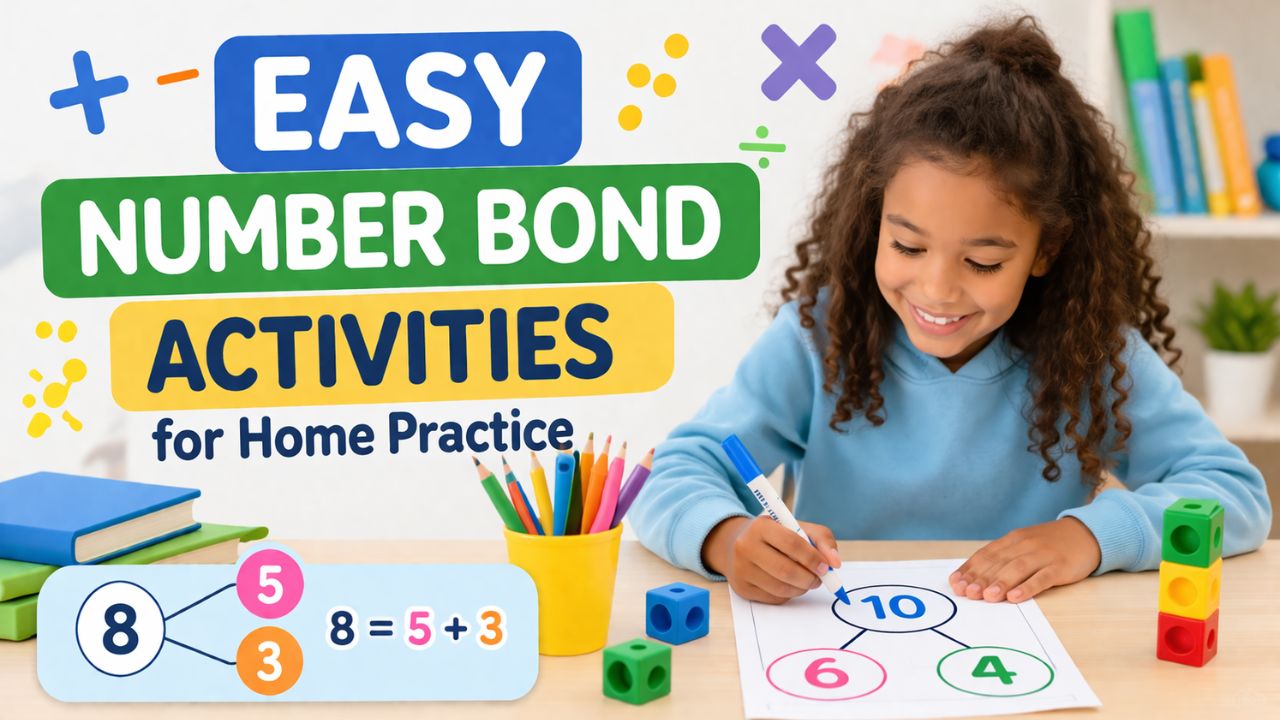
If your child struggles to add or subtract quickly, number bonds are the missing piece. Before multiplication tables, before long division — number bonds are the bedrock of mental maths.
This article is written for parents, carers, and KS1/KS2 teachers who want to help children aged 5–11 build real number fluency at home. Whether your child is just starting out with numbers to 10, or pushing through bonds to 20 and beyond, you’ll find practical activities, step-by-step guidance, and expert tips here.
You’ll also discover how a fast-paced game like Hit the Button can turn five minutes of daily practice into genuine, lasting skills — the kind that make children feel confident in maths lessons, not anxious.
Let’s start from the beginning.
What Are Number Bonds?
A number bond is simply a pair of numbers that add together to make a target number.
For example:
- 3 + 7 = 10
- 6 + 4 = 10
- 8 + 2 = 10
These are all number bonds to 10. The child knows that 3 and 7 are a “bond” — they belong together. When this knowledge becomes automatic, mental maths becomes dramatically faster.
Think of it like learning that “cat” spells c-a-t. Once you just know it, you stop sounding it out every time. Number bonds work exactly the same way.
Number bonds can be made for any target number — 5, 10, 20, 100 — and children will meet all of these throughout KS1 and KS2.
Why Number Bonds Matter So Much
They’re Built Into the National Curriculum
In England, number bonds are explicitly taught from Reception and Year 1. The KS1 curriculum requires children to:
- Know all number bonds to 10 by heart
- Recall number bonds to 20
- Use bonds to work with numbers up to 100
By Year 2, children are expected to retrieve these facts instantly — not calculate them, but know them automatically.
They Speed Up All Future Maths
Once a child knows that 6 + 4 = 10 without thinking, they can use that to solve:
- 16 + 4 = 20
- 60 + 40 = 100
- 6.4 + 3.6 = 10
The same bond powers hundreds of calculations. That’s why early mastery pays off for years.
They Build Maths Confidence
Research in cognitive science consistently shows that reducing the working memory load helps children solve harder problems. When basic facts are automatic, the brain has more space to focus on the actual challenge — like word problems or multi-step calculations.
Children who know their number bonds tend to feel capable in maths. That confidence matters.
Step-by-Step Guide to Teaching Number Bonds at Home
Step 1 – Start With Number Bonds to 5
Before jumping to 10, make sure your child is solid on bonds to 5. These are simple and quick to master.
Bonds to 5:
- 0 + 5
- 1 + 4
- 2 + 3
- 3 + 2
- 4 + 1
- 5 + 0
How to practise: Use five small objects (buttons, coins, grapes). Put some in one hand, the rest in the other. Open both hands and ask: “How many in each hand? What do they add up to?”
Mini tip: Always say the full number sentence out loud — “Two and three make five.” Saying it helps the brain store it.
Step 2 – Build Number Bonds to 10
This is the most important set to master in KS1. Spend the most time here.
All bonds to 10:
| Bond | Total | |
|---|---|---|
| 0 | + 10 | = 10 |
| 1 | + 9 | = 10 |
| 2 | + 8 | = 10 |
| 3 | + 7 | = 10 |
| 4 | + 6 | = 10 |
| 5 | + 5 | = 10 |
How to practise: Draw a ten-frame (a 2×5 grid). Fill in some dots. Ask: “How many more to fill it?” That missing number is the bond.
Mini tip: Point out that the bonds mirror each other — 3+7 and 7+3. This halves the memory load.
Step 3 – Extend to Number Bonds to 20
Once bonds to 10 are secure, move to 20. Encourage children to use their bonds to 10 rather than counting afresh.
Example:
- They know 7 + 3 = 10
- So 17 + 3 = 20 (same bond, just add 10)
- And 7 + 13 = 20 (same pattern again)
How to practise: Write a number between 10 and 20. Ask: “What’s missing to reach 20?” Start with the ones, then carry the ten — it mirrors the bond they already know.
Mini tip: Say: “The ones digits always match a bond you already know.” This is a genuine lightbulb moment for many children.
Step 4 – Move to Bonds to 100
At KS2, children work with bonds to 100. These follow the same logic using multiples of 10.
- 30 + 70 = 100
- 45 + 55 = 100
- 62 + 38 = 100
How to practise: Call out a multiple of 10 (e.g. 40) and ask your child how far to 100. Then try two-digit numbers and practise bridging through tens.
Easy Tricks and Shortcuts That Actually Work
The “10 Frame” Trick Ten frames make number bonds visual. A child can see the gap and instantly identify the missing number without counting.
The “Turnaround Trick” If you know 4 + 6 = 10, you automatically know 6 + 4 = 10. Fewer facts to memorise, double the knowledge.
The “One More, One Less” Ladder Start from 5 + 5 = 10 (the easiest to remember). Then go up and down:
- 6 + 4 = 10 (one more on the left, one less on the right)
- 7 + 3 = 10 (one more again…)
This shows children the pattern rather than asking them to memorise isolated facts.
The “Bridging Through 10” Shortcut For additions like 8 + 5:
- Split 5 into 2 + 3
- Add 2 to 8 to make 10
- Add the remaining 3 → 13
This technique relies entirely on number bond knowledge and is explicitly taught at KS1/KS2 level.
Common Mistakes — and How to Fix Them
1. Counting on fingers for every calculation Why it happens: The child hasn’t internalised the fact yet — they’re still calculating instead of recalling. Fix: Slow down. Drill just one bond per day until it’s automatic. Quality over quantity.
2. Mixing up addition and subtraction bonds Why it happens: Children learn bonds as addition pairs but don’t connect them to subtraction. Fix: Teach the full “fact family” together. If 3 + 7 = 10, then 10 – 7 = 3 and 10 – 3 = 7. Always show all four facts.
3. Rushing to bonds to 20 before bonds to 10 are secure Why it happens: Well-meaning adults want to keep pushing forward. Fix: Test recall speed. If your child takes more than two seconds to recall a bond to 10, they need more time there first.
4. Treating each bond as a separate, unrelated fact Why it happens: Nobody has pointed out the patterns. Fix: Explicitly teach the turnaround rule and the pattern from 0+10 down to 5+5. Show the symmetry on a number line.
5. Forgetting bonds when the problem looks different For example, knowing 4 + 6 = 10 but not recognising 40 + 60 = 100. Fix: Regularly show how bonds “scale up” — using the same digits in different contexts builds flexible thinking.
6. Lacking confidence with subtraction-based bond questions Why it happens: “What is 10 – 4?” feels different from “What goes with 4 to make 10?” Fix: Frame subtraction as “the missing number” rather than “taking away.” The brain finds this easier.
7. Practising only in one format (e.g. only worksheets) Why it happens: It’s convenient, but it doesn’t build speed or automaticity. Fix: Mix formats — verbal quizzes, physical activities, digital games, and written practice all reinforce different aspects of recall.
Fun Practice Methods for Home and School
At-Home Activities
Snap With a Twist Use a pack of cards (remove tens and picture cards). Flip two at a time. If they add to 10, shout “Snap!” First to collect the most pairs wins.
Bond Dominoes Go through a set of dominoes and find all the pieces where the two halves add to 10 (or your target number). Sort them into a “bond pile.”
Bond Challenge at Mealtimes While cooking or eating, call out a number and ask your child for its bond to 10 before the meal reaches the table. Quick, easy, zero prep.
Number Bond Hunt Give your child a total (e.g. 20) and ask them to find as many pairs as they can using numbers around the house — door numbers, clocks, ages. This makes abstract maths feel surprisingly real.
Classroom Activities
Human Number Bonds Give each child a number card. Call out a target. Children with matching bond pairs must find each other and stand together.
Bond Bingo Each child has a bingo card with numbers 0–10. The teacher calls out one half of a bond. Children cover the matching bond partner.
Race to the Wall Stick number bond questions around the classroom. Children run to find the answer, then sprint back to write it down. Gets energy out and practises bonds.
Practise Number Bonds With Hit the Button
One of the most effective tools for building number bond fluency is Hit the Button — a fast-paced, interactive maths game designed specifically for KS1 and KS2 learners.
How it works: A target number appears. Answers pop up on the screen. Players must hit the correct number bond as quickly as possible before the timer runs out.
Why it works so well:
- Speed: The time pressure forces recall rather than calculation — exactly the habit we want to build
- Accuracy: Children quickly notice when they get one wrong, which reinforces self-correction
- Confidence: As scores improve, children can see their own progress — this is hugely motivating
- Flexibility: Hit the Button maths covers number bonds, times tables, division, doubling and halving, and more — so it grows with your child
How to use it effectively at home:
- Play for just 5 minutes a day — short bursts beat long sessions
- Start on the easier number bond levels (bonds to 10) before moving up
- Challenge children to beat their own score, not someone else’s
- Use it as a warm-up before homework or a cool-down after a maths lesson
This game is also brilliant in a classroom setting — it works as a quick starter activity, an end-of-lesson challenge, or a class competition on the whiteboard.
Whether you search for “hit the button maths,” “hit the button game,” or just “press the button maths,” you’ll find it’s become one of the most trusted free maths tools in UK primary schools — and for very good reason.
Practice Questions
Try these with your child. Start without a timer, then gradually build speed.
Bonds to 10:
- 3 + __ = 10
- __ + 8 = 10
- 10 – 6 = __
- What bonds to 10 with 9?
Bonds to 20: 5. 13 + __ = 20 6. __ + 15 = 20 7. 20 – 11 = __
Bonds to 100: 8. 40 + __ = 100 9. __ + 65 = 100 10. 100 – 73 = __
Mixed challenge: 11. If 7 + 3 = 10, what is 70 + __ = 100? 12. A bag has 20 sweets. 12 have been eaten. How many are left?
Answers:
- 7 | 2. 2 | 3. 4 | 4. 1 | 5. 7 | 6. 5 | 7. 9 | 8. 60 | 9. 35 | 10. 27 | 11. 30 | 12. 8
Expert Tips for Parents and Teachers
Don’t rush the fundamentals. It can feel slow to spend weeks on bonds to 10. But children who truly master this foundation learn everything else faster. Patience here pays enormous dividends.
Praise effort, not just correct answers. When a child self-corrects or tries a different strategy, acknowledge it. This builds mathematical resilience.
Make bonds visible in the home. Stick a number bond rainbow on the fridge. Write bond pairs on a whiteboard. Passive exposure adds up over time.
Use the “three before me” rule in classrooms. Before asking the teacher, children must try the question three different ways (counting, using a tens frame, recalling a known fact). This builds independent thinking.
Test for automaticity, not just accuracy. A child who gets every answer right but takes 5–10 seconds per answer isn’t fluent yet. Speed matters because it indicates the fact is truly stored in long-term memory.
Connect bonds to real purchases. Give a child 10p and let them buy something for 3p. Ask: “How much change should you get?” Real-world maths is deeply memorable.
Advanced Insight: Why Automaticity Changes Everything
There’s an important distinction in maths education between knowing a fact and retrieving it automatically.
When a child calculates 7 + 3 by counting up from 7… they’re using working memory. Working memory has a very limited capacity — roughly 4 chunks of information at once. When a child is solving a multi-step word problem and has to also calculate basic bonds on the fly, their working memory fills up. Errors increase. Frustration follows.
But when 7 + 3 = 10 is automatic — stored in long-term memory and retrieved without effort — working memory stays free for the hard part: understanding the problem, planning the method, checking the answer.
This is why number bond fluency isn’t just about speed. It’s about freeing up cognitive resources for higher-order thinking.
The progression that works best:
- Understanding — Why does 7 + 3 = 10? Use objects and visuals.
- Reasoning — What patterns can I see? (Turnarounds, symmetry, bridges)
- Fluency — Can I recall this without thinking? (Daily practice, timed activities)
- Application — Can I use this bond to solve new problems? (Word problems, scaled-up versions)
Many children are taken straight from step 1 to step 4 without building steps 2 and 3. That’s where the gaps come from.
You can also extend this into related skills — once number bonds are secure, doubling and halving, times tables, and even fraction work all become noticeably easier. These topics are all deeply connected under the surface.
Frequently Asked Questions
Q: What age should children learn number bonds? Number bonds to 5 are introduced in Reception (age 4–5). Bonds to 10 are a core Year 1 target. Bonds to 20 are expected by end of Year 2. Most children revisit and extend this knowledge throughout KS2.
Q: What is Hit the Button and how does it help with number bonds? Hit the Button is a free online maths game widely used in UK primary schools. Players hit the correct answer before the timer runs out. It builds speed, accuracy, and confidence with number bonds, times tables, and more. Searching “hit the button maths” or “hit the button game” will bring it up immediately.
Q: How long should children practise number bonds each day? Five to ten minutes of focused, daily practice is far more effective than a one-hour session once a week. Little and often is the golden rule for building automatic recall.
Q: My child can do number bonds slowly but not quickly — what should I do? This means the understanding is there but automaticity isn’t. Switch to activities that require faster responses — like timed card games, verbal quizzes, or digital games like Hit the Button. The time pressure builds speed without pressure from an adult.
Q: Are number bonds the same as addition facts? They overlap but aren’t identical. Number bonds specifically focus on pairs that make a target total (like bonds to 10 or bonds to 20). Addition facts is a broader term covering any addition. Think of number bonds as a specific, highly useful subset of addition knowledge.
Q: What if my child keeps getting bonds to 20 wrong? Go back to bonds to 10 first. Bonds to 20 directly rely on them. If bonds to 10 aren’t automatic, bonds to 20 will always feel like hard work. Mastering the foundation fixes most of the problems above it.
Q: Can I use Hit the Button for times tables practice too? Absolutely. Hit the Button times tables mode works on exactly the same principle — fast recall under time pressure. It covers all tables from 2 to 12 and is excellent for KS2 children preparing for the Year 4 Multiplication Tables Check (MTC).
Conclusion: Small Practice, Big Results
Number bonds aren’t exciting to talk about, but they’re genuinely transformative when children know them well. The child who walks into Year 3 with rock-solid bonds to 20 has a genuine head start — in mental maths, in written calculations, and in confidence.
The good news is that home practice doesn’t need to be complicated or time-consuming. A few minutes of games, a quick verbal quiz at the dinner table, or five minutes on Hit the Button before bedtime — these small habits build the kind of automatic recall that lasts.
Start with bonds to 5. Build to 10. Extend to 20. Then watch how naturally everything else follows.
The maths is simple. The practice is easy. The results are real.