

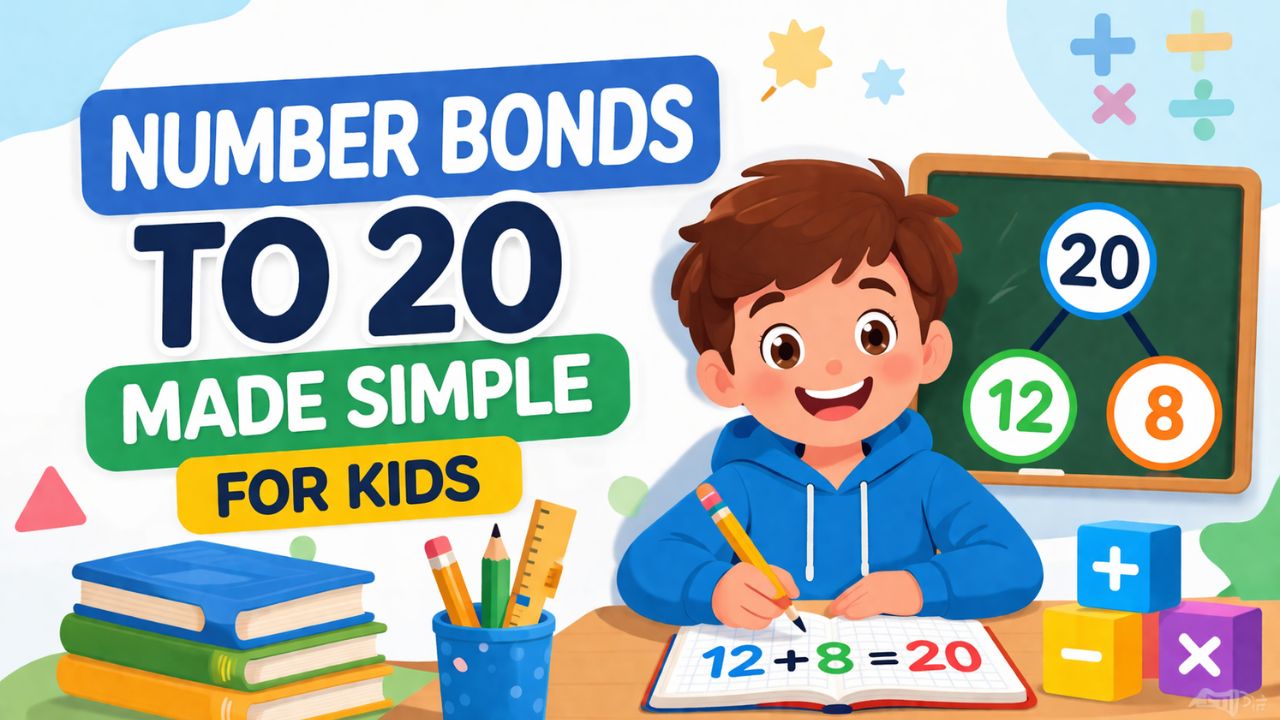
If your child is in Year 1 or Year 2, you’ve probably heard their teacher mention number bonds. Maybe your child came home with a worksheet, or perhaps they’re practising on a maths game like Hit the Button — one of the most popular tools used in UK primary schools today.
This article will walk you through everything you need to know about number bonds to 20: what they are, why they matter, how to learn them step by step, and how to practise them so they actually stick.
Whether you’re a parent trying to help at home, a teacher looking for fresh ideas, or a child who wants to get faster at maths — you’re in exactly the right place.
By the end, your child will have a solid understanding of every number bond to 20, some clever shortcuts to remember them, and a fun way to practise using an interactive game.
Let’s get started.
What Are Number Bonds to 20?
A number bond is simply two numbers that add together to make a target number.
Number bonds to 20 are all the pairs of whole numbers that add up to exactly 20.
Here are all of them:
| Number Bond | Calculation |
|---|---|
| 0 + 20 | = 20 |
| 1 + 19 | = 20 |
| 2 + 18 | = 20 |
| 3 + 17 | = 20 |
| 4 + 16 | = 20 |
| 5 + 15 | = 20 |
| 6 + 14 | = 20 |
| 7 + 13 | = 20 |
| 8 + 12 | = 20 |
| 9 + 11 | = 20 |
| 10 + 10 | = 20 |
That’s 11 pairs in total. And once your child knows that 7 + 13 = 20, they also automatically know that 13 + 7 = 20. That doubles the value of each fact they learn.
Think of number bonds like a friendship between two numbers — they always go together to make 20.
Why This Skill Matters
In School (KS1 and KS2)
Number bonds to 20 appear in the KS1 National Curriculum and are expected to be known by heart by the end of Year 2. The UK Department for Education lists them as a key milestone in early maths development.
They form the foundation for:
- Addition and subtraction fluency
- Mental maths strategies
- Column addition in KS2
- Understanding place value
- Eventually, multiplication and division reasoning
A child who doesn’t know their number bonds will struggle with almost every other area of primary maths. It’s that fundamental.
In Real Life
Number bonds aren’t just a school thing. They appear in everyday situations:
- Giving change (20p – 7p = 13p)
- Scoring in games (7 points, need 13 more to reach 20)
- Sharing items (20 sweets between different groups)
- Cooking and measuring
The Cognitive Benefit
Knowing number bonds frees up working memory. When a child has to work out 8 + 12 every single time, their brain is too busy to focus on the bigger problem. When they know it instantly, they can think at a higher level.
Research in mathematics education consistently shows that automaticity — knowing facts without thinking — is one of the strongest predictors of maths success.
Step-by-Step Learning Guide
Step 1: Start With Number Bonds to 10
Before tackling 20, make sure your child is confident with bonds to 10.
Why? Because bonds to 20 are built on top of them.
If they know 3 + 7 = 10, they can extend this: 13 + 7 = 20. The pattern is the same — you’ve just added 10 to one of the numbers.
Examples:
- 2 + 8 = 10 → 12 + 8 = 20
- 4 + 6 = 10 → 14 + 6 = 20
- 5 + 5 = 10 → 15 + 5 = 20
Mini tip: Spend 5 minutes on bonds to 10 before every session until they’re instant. Then move to 20.
Step 2: Learn the “Anchor” Bonds First
Some bonds are easier to remember. Start with these:
- 10 + 10 = 20 (the middle bond — doubles are easy)
- 20 + 0 = 20 (adding nothing)
- 15 + 5 = 20 (counting to 20 in fives is natural)
- 11 + 9 = 20 (close to 10 + 10)
Once a child knows these four, they have anchors that help them work out the rest.
Mini tip: Use your fingers to show 10 + 10 physically. Hold up all ten fingers and say “ten more makes twenty.”
Step 3: Use the “What’s Missing?” Approach
Instead of always asking “what is 7 + 13?”, flip the question:
“7 + ___ = 20. What’s missing?”
This is called a missing number problem, and it’s extremely powerful for building real understanding — not just memorisation.
It also mirrors exactly how number bonds appear in KS1 assessments and SATs-style questions.
Practice examples:
- 6 + ___ = 20 (answer: 14)
- ___ + 12 = 20 (answer: 8)
- 20 – 9 = ___ (answer: 11)
Mini tip: Write a number bond on a sticky note and stick it on the fridge. Change it each morning. Ask at breakfast: “What’s missing?”
Step 4: Connect Addition to Subtraction
Every addition bond creates two subtraction facts automatically.
3 + 17 = 20 gives you:
- 20 – 3 = 17
- 20 – 17 = 3
That means learning 11 addition bonds actually gives you 33 related facts (11 additions + 22 subtractions). That’s brilliant value for the effort.
Mini tip: Every time your child learns a new bond, ask them: “So what’s 20 minus that number?” Reinforce the connection every single time.
Easy Tricks and Shortcuts
The Mirror Trick
Number bonds mirror each other. Once you know one half, you know the other.
If 4 + 16 = 20, then 16 + 4 = 20. Same bond, flipped around.
This means your child only needs to learn 6 unique bonds (plus the double: 10 + 10), and the rest are mirrors.
The “Count Up From 10” Strategy
If your child is stuck on a bond, teach them to count up from 10 to 20:
“I need 8 + ___. I know 8 + 2 = 10. Then I need 10 more. So it’s 8 + 12.”
This two-step method works reliably and quickly.
The Doubles Anchor
10 + 10 = 20 is the centre of all bonds to 20.
Teach your child to think of bonds as being “above and below” the doubles:
- 9 + 11 (one less, one more than 10+10)
- 8 + 12 (two less, two more)
- 7 + 13 (three less, three more)
Seeing the pattern this way makes the whole set feel logical — not like 11 separate facts to memorise.
Colour Coding
Write each bond pair in a matching colour. 7 and 13 in red. 6 and 14 in blue. This helps visual learners connect the pairs in memory.
Common Mistakes and How to Fix Them
Mistake 1: Confusing Bonds to 10 and Bonds to 20
Why it happens: Children learn bonds to 10 first, so the two sets get mixed up. Fix: Clearly label worksheets and games. Always say “to 20” out loud. Colour-code them differently.
Mistake 2: Thinking Order Matters
Why it happens: Children learn 3 + 17 but don’t realise 17 + 3 is the same. Fix: Show commutativity physically with blocks or counters. Move the groups around. The total doesn’t change.
Mistake 3: Skipping the Subtraction Connection
Why it happens: Addition and subtraction feel like separate topics. Fix: Always teach the full “family” of facts together: 3 + 17 = 20, 17 + 3 = 20, 20 – 3 = 17, 20 – 17 = 3.
Mistake 4: Relying on Fingers Too Long
Why it happens: Counting on fingers works at first, so children stick with it. Fix: Set speed challenges. If they’re still counting fingers, slow down and practise the bonds more before expecting speed.
Mistake 5: Guessing Under Pressure
Why it happens: Speed games (like Hit the Button maths) can make children anxious, so they rush and guess. Fix: Start slow. Accuracy before speed. Let them play at a comfortable pace and build up gradually.
Mistake 6: Not Reviewing Regularly
Why it happens: A child learns bonds in a week, then forgets them a month later. Fix: Little and often beats long cramming sessions. Even 3 minutes of daily practice keeps bonds sharp.
Mistake 7: Learning Bonds in Isolation
Why it happens: Worksheets often drill one format only. Fix: Vary the format — addition, subtraction, missing number, word problems. The more contexts they see it in, the deeper the understanding.
Fun Practice Methods
At Home
- Snap with cards: Remove face cards from a deck. Draw two and ask if they bond to 20.
- Bond of the Day: Each morning, write one bond on a whiteboard. Quiz your child at dinner.
- 20-second challenge: How many bonds can they recall in 20 seconds? Time it and try to beat it each day.
- Cooking maths: “We need 20 raisins. You’ve put in 7. How many more?”
In the Classroom
- Bond relay: Split class into teams. Call out a number. First to shout the partner number wins a point.
- Missing number bingo: Bingo cards with numbers 0–20. Teacher calls missing numbers in bonds.
- Partner quiz: Children quiz each other for 2 minutes at the start of maths lessons.
- Bond wall display: A classroom display showing all bonds to 20 that children contribute to together.
Real-Life Applications
- Scoring games at home (first to 20 wins — what do you need?)
- Shopping (spending from a £20 note — how much change?)
- PE (20 star jumps done — how many left?)
🎮 Practise This Skill Using Our Game
One of the best tools for practising number bonds to 20 is Hit the Button — a fast-paced, interactive maths game used by thousands of UK primary school children every week.
Here’s why it works so well:
Speed: Hit the Button presents number bonds rapidly, one after another. This trains your child to recall answers instantly — exactly the automaticity that boosts classroom performance.
Accuracy: The game tracks correct answers, so children can see their score improve over time. That sense of progress is motivating.
Confidence: Repeated success in a game setting translates directly to confidence in class. Children who play regularly stop dreading mental maths and start enjoying it.
Flexibility: You can target number bonds to 10, number bonds to 20, times tables, and more — all in one place. It’s a complete mental maths workout.
To get the most out of it:
- Start with number bonds to 10 if your child is a beginner
- Move to number bonds to 20 once they’re fluent
- Aim for at least 3 sessions per week, 5 minutes each
- Focus on accuracy first — speed will follow naturally
Play Hit the Button now and see how quickly your child’s score improves.
You can also use Hit the Button to practise times tables, division facts, and doubling and halving — so it grows with your child through KS1 and KS2.
Practice Questions
Try these yourself. Answers are at the bottom.
Beginner:
- 10 + ___ = 20
- ___ + 5 = 20
- 20 – 6 = ___
- 18 + ___ = 20
Intermediate: 5. ___ + 13 = 20 6. 20 – 14 = ___ 7. 9 + ___ = 20 8. What two numbers bond to make 20 if one of them is 16?
Challenging: 9. I have 20 stickers. I give away 7. How many do I have left? 10. Jack has 8 points. He needs 20 to win. How many more does he need? 11. Fill in both missing numbers: ___ + ___ = 20 (where both numbers are even and neither is 10) 12. True or false: 20 – 15 = 5. Explain how you know.
Answers:
- 10 | 2. 15 | 3. 14 | 4. 2 | 5. 7 | 6. 6 | 7. 11 | 8. 4
- 13 | 10. 12 | 11. Multiple answers — e.g. 8 + 12, 4 + 16, 6 + 14 | 12. True — because 5 + 15 = 20
Expert Tips for Parents and Teachers
1. Don’t drill before understanding is in place. Rushing to speed practice before a child understands what number bonds are creates fragile knowledge. It breaks under pressure. Build understanding first, then automate it.
2. Use verbal recall, not just written. Ask number bond questions out loud during car journeys, walks, or meal times. The brain encodes spoken recall differently to written — and it’s more natural for young children.
3. Praise the process, not just the answer. “I love how you thought about that” beats “well done, correct” for long-term motivation. Children who are praised for effort engage more deeply with learning.
4. Play games before worksheets. Games create emotional engagement. Worksheets are valuable, but a child who plays a maths game first arrives at the worksheet with more enthusiasm and better recall.
5. Track progress visibly. A simple chart on the fridge showing daily scores from Hit the Button maths is a powerful motivator. Children love seeing their own improvement.
6. Teach the inverse relationship early. Don’t wait until Year 2 to connect addition and subtraction. From the very first bond lesson, show the subtraction facts too. It halves the amount your child needs to learn separately.
7. Connect to bonds to 10 constantly. Every bonds-to-20 lesson should start with a 60-second bonds-to-10 warm-up. The two sets reinforce each other beautifully.
Advanced Insight: Why Number Bonds Build Mathematical Thinking
Most articles about number bonds focus on memorisation. But there’s something deeper happening when children learn them well.
Number bonds develop part-whole thinking — the ability to see a number as made up of smaller parts. This is fundamentally different from counting, and it’s a major cognitive leap.
A child who thinks in part-whole terms understands that 20 isn’t just “the number after 19” — it’s a flexible quantity that can be split in multiple ways. That flexibility is the foundation of all algebraic thinking, and it begins here.
Pattern recognition is another key benefit. When a child notices that 1+19, 2+18, 3+17 follow a predictable pattern (one goes up, one goes down), they’re doing early algebraic reasoning. They’re generalising — one of the highest-order mathematical skills.
This is why teachers don’t just want children to memorise bonds, but to see them. The goal is a child who looks at 20 and immediately thinks about its component parts, not one who recites a list by rote.
Games like Hit the Button reinforce this because they present bonds in varied orders, stopping rote recitation from being enough. Children have to know the relationships, not just remember a sequence.
Frequently Asked Questions
Q: What age should children learn number bonds to 20? Number bonds to 10 are typically taught in Year 1 (ages 5–6). Number bonds to 20 are usually introduced in Year 1 and consolidated in Year 2 (ages 6–7). Some children may be ready earlier.
Q: What’s the difference between Hit the Button and other maths games? Hit the Button maths is specifically designed to build speed and automaticity in mental maths facts. Unlike many maths games that focus on understanding, Hit the Button trains recall — which is what children need once understanding is in place.
Q: How long does it take to learn all number bonds to 20? With regular practice (5–10 minutes daily), most children can achieve confident recall within 4–6 weeks. Consistency matters far more than session length.
Q: Should children use Hit the Button before or after learning bonds in class? Both! Use it during learning to reinforce new bonds, and after to maintain and build speed. Even children who know their bonds well benefit from regular game-based practice.
Q: How are number bonds to 20 linked to times tables? They’re part of the same mental maths progression. Children who are fluent in number bonds find it easier to learn multiplication facts because the same memory and pattern-recognition skills are involved. You’ll find times tables practice on Hit the Button too.
Q: My child knows the bonds but is slow. What should I do? This is completely normal. Understanding comes before speed. Play Hit the Button daily for short sessions and track their time. Speed increases naturally with repetition — don’t rush it or create anxiety around it.
Q: What comes after number bonds to 20? The natural next steps are number bonds to 100 (bonds in multiples of 10), doubling and halving, and then times tables. All of these are available to practise with the Hit the Button game.
Conclusion: You’ve Got This
Number bonds to 20 might seem like a small topic, but they’re one of the most important maths skills a child can have in KS1 and KS2.
When your child knows these bonds by heart — truly knows them, without counting on fingers or pausing to think — their entire relationship with maths changes. Mental arithmetic becomes easier. Confidence in class grows. Harder topics feel less scary.
The key takeaways:
- Build on bonds to 10 first
- Learn anchor bonds, then fill in the rest
- Always connect addition facts to subtraction
- Practise little and often — 5 minutes daily beats 30 minutes once a week
- Use games like Hit the Button to build real speed and confidence
Your child doesn’t need to be a “maths person” to master this. They just need the right approach, a little patience, and some regular practice.
Start today. Five minutes with Hit the Button, a bond-of-the-day on the fridge, and a question on the school run. That’s it. Within a few weeks, you’ll be amazed at the difference.
Ready to practise? Hit the Button is waiting.