

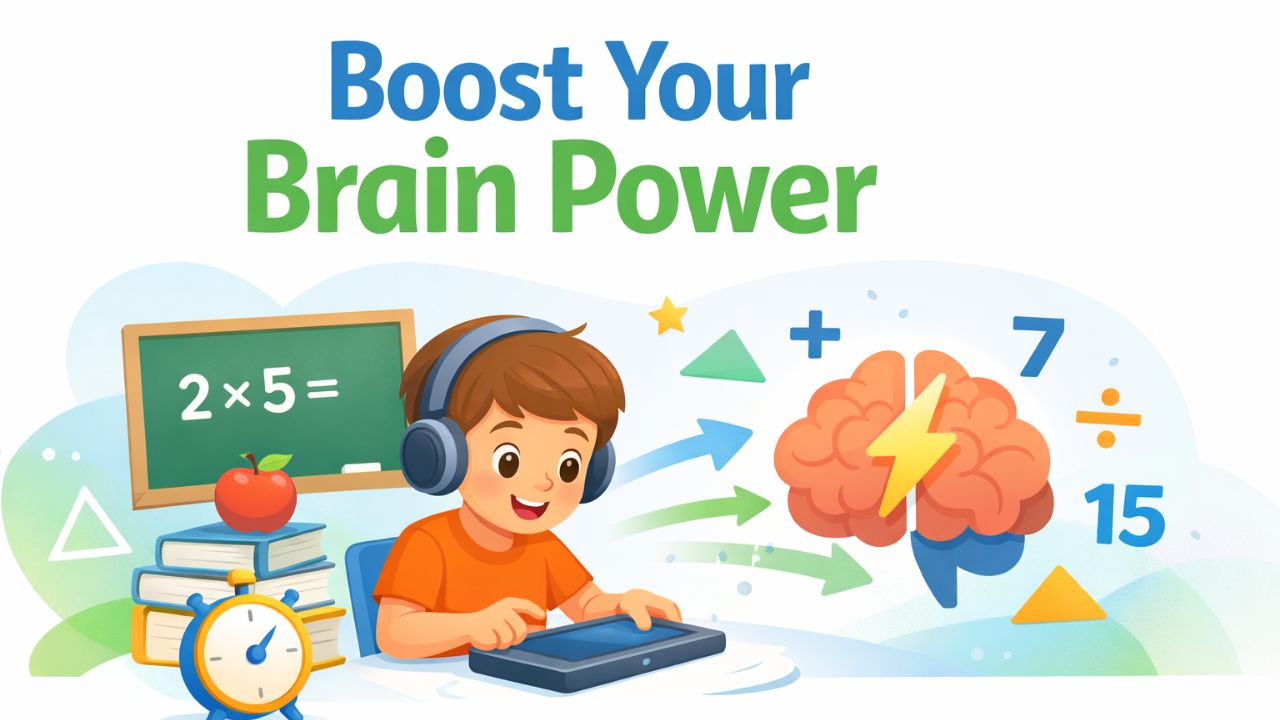
Why Playing Fast Makes Children Think Smarter
Ask any parent or teacher and they will tell you the same thing — children learn best when they are having fun. But what if a simple game on a screen was doing far more than entertaining your child? What if pressing buttons quickly, racing against a timer, and answering maths questions at speed was actually rewiring how their brain works?
This article explores exactly that. Whether you are a parent looking for ways to support your child’s learning at home, or a teacher searching for tools that genuinely work in the classroom, you are in the right place.
We will look at how speed-based maths games — including the popular Hit the Button game — help children build faster recall, sharper thinking, and stronger confidence in maths. You will also find practical tips, common mistakes to avoid, and ready-to-use practice questions.
By the end, you will understand why letting your child play Hit the Button is not just screen time — it is some of the most productive learning they can do.
What Are Speed-Based Learning Games?
Speed-based learning games are educational games where a child must answer questions quickly, usually against a ticking clock or a disappearing target. The faster and more accurately they respond, the better their score.
Hit the Button maths is a brilliant example. Children see a question — such as 6 × 7 or half of 48 — and must tap or click the correct answer before it disappears. The game rewards both speed and accuracy, which makes it uniquely powerful for learning.
Unlike traditional worksheets, these games create a sense of urgency. That urgency is not just excitement — it is the brain working harder than usual, forming stronger memory connections with each correct answer.
Think of it like this: if you practise riding a bike slowly every day, you will eventually get it. But if you practise on a slight slope — with a little pressure — you learn much faster. Speed games are that slope.
Why Speed Matters in Maths Learning
You might wonder: why does speed matter? Surely getting the right answer is enough?
In primary school maths, fluency — the ability to recall facts quickly and accurately — is just as important as understanding. The UK National Curriculum places significant emphasis on this, particularly for KS2 pupils.
The Year 4 Multiplication Tables Check (MTC) is a clear example. Children are tested on their times tables under timed conditions, with only 6 seconds to answer each question. If a child cannot recall 7 × 8 instantly, they struggle — not just in the test, but in every area of maths that builds on multiplication.
Speed-based games like Hit the Button train exactly this skill. They build what researchers call automaticity — the ability to answer without having to stop and think. When maths facts become automatic, children free up mental energy for harder problems.
This is why speed matters. It is not about rushing — it is about building the mental foundation for everything that comes next.
Cognitive Benefits of Speed-Based Maths Practice
- Working memory improvement — children hold and process information faster
- Pattern recognition — they begin spotting number relationships automatically
- Reduced maths anxiety — confidence builds as recall becomes effortless
- Better problem-solving — with basic facts handled automatically, the brain focuses on reasoning
- Increased attention span — short, fast games train focus in manageable bursts
Step-by-Step: How to Use Speed Games for Maximum Learning
Speed-based games work best when used with intention, not just as a free-play activity. Here is how to get the most out of games like Hit the Button hit the button maths sessions at home or in school.
Step 1: Start With One Skill at a Time
Explanation: Before playing on full random mode, choose a specific skill. For younger children (KS1), this might be number bonds to 10. For older pupils (KS2), it might be the 7 times table or division facts.
Example: Set Hit the Button to “Times Tables — 6×” so your child only sees 6× questions. Focused practice on one table builds a solid foundation before mixing tables together.
Mini tip: Spend two to three sessions on the same skill before moving on. Repetition with a slight time pressure is exactly what builds automaticity.
Step 2: Track Progress Over Sessions
Explanation: Speed games become truly powerful when children can see their own improvement. Encourage your child to note their score each time they play and try to beat it next session.
Example: If they scored 14 out of 25 on Monday, challenge them to reach 18 by Wednesday. Small, achievable targets keep motivation high.
Mini tip: A simple hand-drawn score chart on the fridge works brilliantly. Children love seeing their progress visually.
Step 3: Gradually Increase Difficulty
Explanation: Once a child can score consistently well on a single skill, it is time to widen the challenge. Move from one times table to two, or from number bonds to 10 to number bonds to 20.
Example: A child confident with the 3× and 4× tables can try mixed mode, which presents both randomly — exactly the condition they will face in the MTC.
Mini tip: Never rush this step. Confidence at the current level should always come before stretching to the next.
Step 4: Play Little and Often
Explanation: Ten minutes of Hit the Button maths every day is significantly more effective than one hour on a Saturday. This is because the brain consolidates learning during short, repeated exposures — a concept known as spaced practice.
Example: A five-minute session before school, or straight after homework, is enough to make real progress within a few weeks.
Mini tip: Set a consistent time each day. Routine removes resistance and makes practice feel normal rather than a chore.
Easy Tricks and Shortcuts for Faster Maths Recall
Speed games reward children who already know a few clever shortcuts. Teaching these alongside game practice accelerates progress significantly.
The 9× finger trick: Hold up both hands. To calculate 9 × 4, fold down the fourth finger from the left. The fingers to the left (3) give the tens digit, the fingers to the right (6) give the units digit. Answer: 36. Children love this trick and remember it instantly.
Doubling for the 4× table: Instead of memorising 4× separately, teach children to double the number, then double it again. 4 × 7 = double 7 (14), double 14 = 28. Simple and fast.
The 5× shortcut: Anything multiplied by 5 is simply half of that number multiplied by 10. So 5 × 8 = half of 80 = 40. Once children grasp this, the 5× table becomes effortless.
Square numbers pattern: Knowing square numbers (1, 4, 9, 16, 25, 36, 49, 64, 81, 100) helps enormously in Hit the Button times tables mode because they appear frequently across different tables.
Commutative law reminder: Remind children that 6 × 7 and 7 × 6 give the same answer. This halves the number of facts they need to learn from scratch.
Common Mistakes Children Make — and How to Fix Them
1. Clicking randomly to get lucky
Why it happens: The pressure of the timer makes some children panic and click anything. Fix: Lower the difficulty or slow down the mode. Accuracy should come before speed.
2. Skipping hard questions and hoping for easy ones
Why it happens: Children avoid facts they do not know, so those gaps never get filled. Fix: Identify the skipped facts and practise those specifically outside of game sessions first.
3. Practising the same easy skill every time
Why it happens: Success feels good, so children stick to what they already know. Fix: Set a rule — once a score is consistently above 20/25, it is time to move to a harder setting.
4. Playing for too long in one sitting
Why it happens: The game is engaging, so children do not want to stop. Fix: Set a timer. Fifteen minutes is a healthy cap for a single session. Beyond that, focus drops.
5. Not reviewing wrong answers
Why it happens: After the game ends, children want to play again immediately rather than reflect. Fix: After each session, ask “Which questions did you get wrong?” and spend two minutes on just those facts.
6. Relying on counting strategies during timed play
Why it happens: If children have not yet memorised a fact, they resort to counting on fingers, which is far too slow. Fix: Practise that specific fact verbally — say it out loud ten times — before returning to timed games.
7. Losing motivation after a bad score
Why it happens: Timed pressure can feel defeating, especially if progress slows. Fix: Celebrate attempts, not just scores. Remind children that every session — even a tough one — is building the brain.
Fun Practice Methods Beyond the Screen
While Hit the Button is excellent, combining it with offline practice makes learning even more powerful.
At home:
- Stick times tables posters in the bathroom or bedroom — passive exposure works
- Use a kitchen timer and quiz your child verbally at the dinner table
- Play “fastest finger” — call out a maths fact and see who in the family answers first
In the classroom:
- Display a “Table of the Week” and test pupils at the start and end of the week
- Run a two-minute Hit the Button maths session on the interactive whiteboard as a class warm-up
- Pair pupils and have them quiz each other using flashcards before a game session
Real-life applications:
- Shopping maths — ask your child to calculate 4 items at £3 each while in the supermarket
- Cooking — double or halve a recipe together, turning it into a live maths challenge
- Sport scores — calculate cumulative scores during a match using multiplication
You can also practise number bonds, division facts, doubling and halving, and square numbers alongside your Hit the Button game sessions for a well-rounded maths routine.
Practise This Skill Using Hit the Button
If you want to see real improvement — quickly — there is one tool that consistently delivers results for KS1 and KS2 children: Hit the Button.
The Hit the Button game is designed specifically for primary school learners. It covers:
- Times tables (2× through to 12×)
- Division facts
- Number bonds (to 10, 20, and 100)
- Doubling and halving
- Square numbers
What makes press the button maths so effective is the combination of speed, accuracy, and immediate feedback. Children know instantly whether they are right or wrong, and the score system gives them a clear goal to beat.
Unlike passive revision, the game puts children in an active, pressured state — which is precisely when the brain encodes information most effectively.
Parents love it because there is no setup required and children return to it willingly. Teachers value it because it maps directly onto curriculum objectives and the Year 4 MTC format.
Whether you call it push the button maths, hit the butten, or simply the button game — the learning it delivers is real, measurable, and enjoyable.
Start with five minutes today. The results will speak for themselves.
Practice Questions
Try these questions yourself — or use them to quiz a child before or after a game session.
Questions:
- 6 × 7 = ?
- Half of 64 = ?
- 9 × 8 = ?
- Number bonds: 37 + ? = 100
- 12 × 11 = ?
- Double 45 = ?
- 48 ÷ 6 = ?
- 7 × 7 = ?
- Half of 130 = ?
- Number bonds: 56 + ? = 100
- 8 × 9 = ?
- 144 ÷ 12 = ?
Answers:
- 42
- 32
- 72
- 63
- 132
- 90
- 8
- 49
- 65
- 44
- 72
- 12
Expert Tips for Parents and Teachers
For parents:
Start sessions when your child is alert — not tired. Evening game sessions after a long school day will produce weaker results than a short morning burst.
Avoid making practice feel like punishment. Frame it as “let us see how fast you can get today” rather than “you have to do your tables.”
Do not compare your child to classmates. Their competition should only ever be their previous score.
For teachers:
Use Hit the Button as a low-stakes assessment tool. Running the same activity twice — once at the start of a unit and once at the end — gives you a clear, visible record of progress.
Incorporate game time into morning registration or transition periods. Even three minutes of focused hit the button times tables practice at the start of a lesson improves engagement for the lesson that follows.
Consider using mixed-table mode from Year 3 onwards to prepare children for the randomised format of the MTC well in advance.
Advanced Insight: The Science Behind Why Speed Games Work So Well
Most articles tell you that practice makes perfect. What they do not explain is why speed-based practice works better than standard revision.
When a child answers a maths question under mild time pressure, the brain releases a small amount of adrenaline. This heightened state improves encoding — the process by which information moves from short-term to long-term memory. Psychologists call this the arousal-performance relationship, and it explains why children often remember facts learned under gentle pressure more reliably than facts studied casually.
Speed games also exploit a powerful learning mechanism known as retrieval practice. Every time a child is forced to recall an answer — rather than simply read it — the memory trace for that fact becomes stronger. Each correct answer under pressure is like adding another layer of cement to a foundation.
There is also the role of interleaved practice — mixing different question types randomly, as Hit the Button does in its mixed modes. Research consistently shows that interleaved practice produces stronger long-term retention than blocked practice (repeating the same fact over and over). This is because the brain has to work harder to locate the right answer, which strengthens the retrieval pathway.
Put simply: the game is hard by design — and that difficulty is precisely what makes it work.
Frequently Asked Questions
What is Hit the Button and who is it for? Hit the Button is an online maths game designed for primary school children aged 6 to 11. It covers times tables, number bonds, division, doubling, halving, and square numbers. It is used by both parents at home and teachers in the classroom.
How long should my child play Hit the Button each day? Five to fifteen minutes of focused play each day is ideal. Short, regular sessions are more effective than occasional long ones because of how the brain consolidates memory through spaced repetition.
Does Hit the Button maths help with the Year 4 Multiplication Tables Check? Yes. The game format closely mirrors the timed, randomised nature of the MTC. Regular play builds both the speed and accuracy needed to perform well in the check.
My child keeps getting the same questions wrong — what should I do? Identify those specific facts and practise them verbally away from the screen first. Repetition at low speed helps the brain store the fact before timed pressure is reintroduced.
Is Hit the Button suitable for KS1 children? Absolutely. The game includes easier settings such as number bonds to 10 and simple doubling, which are perfectly matched to KS1 expectations.
Can teachers use Hit the Button as a whole-class activity? Yes — it works brilliantly on an interactive whiteboard. You can display it for the class to answer together, use it as a warm-up activity, or let pupils take turns individually.
What other maths skills should children practise alongside Hit the Button? Complement game sessions with work on number bonds, place value, mental addition and subtraction, and column methods. A broad and well-practised foundation makes Hit the Button progress even faster.
Conclusion
Speed-based maths games are not a gimmick. They are one of the most effective, research-backed tools available for building the kind of automatic recall that primary school children need — and that stays with them for life.
Hit the Button combines everything that makes learning stick: time pressure, immediate feedback, repetition, and variety. Whether your child is working on hit the button times tables, number bonds, or division facts, every session is quietly building a faster, more confident mathematical mind.
The key is consistency. Five minutes every day beats one hour every weekend. Pick a time, make it a routine, and watch the scores — and the confidence — grow.
Start today. The brain your child builds now will carry them through every maths lesson, every test, and every real-world problem they ever face.