
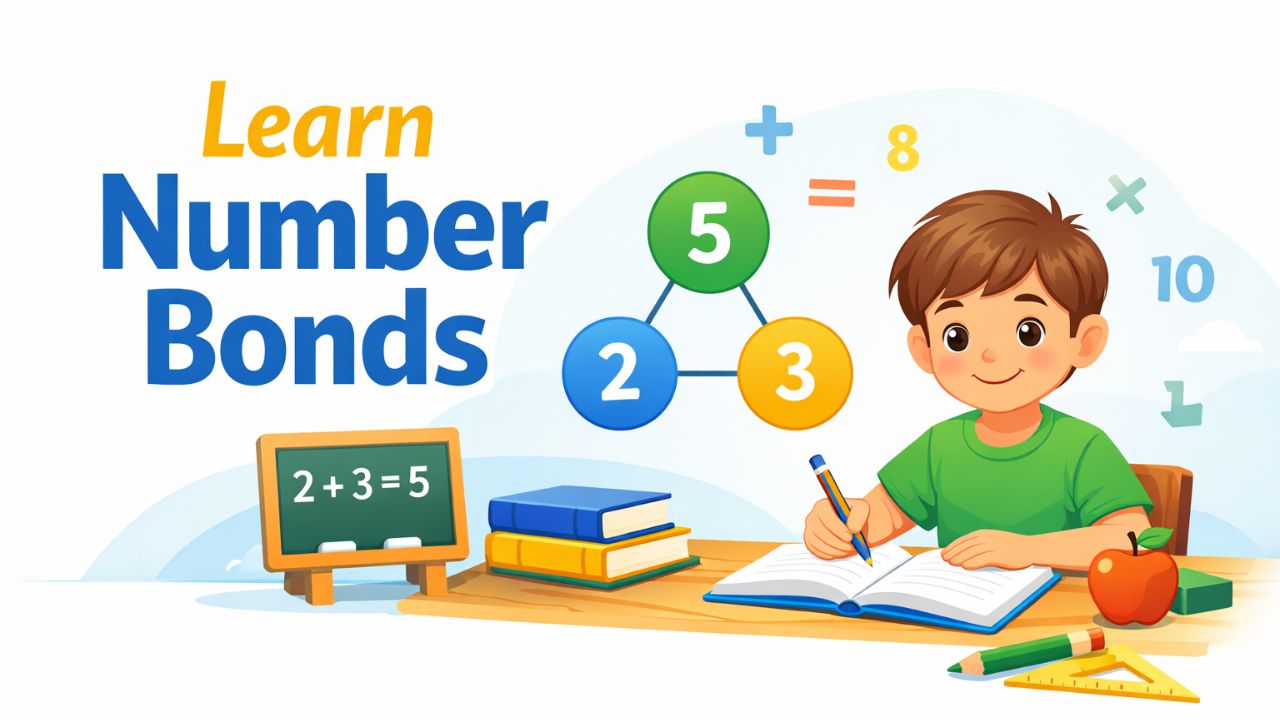
If your child has come home talking about number bonds — or you’ve spotted them on a maths worksheet — you’re in the right place.
Number bonds are one of the most important building blocks in primary maths. Once a child truly understands them, everything else — addition, subtraction, mental arithmetic — becomes dramatically easier.
In this guide, you’ll learn exactly what number bonds are, why they matter, and how to teach them in a way that actually sticks. Whether you’re a parent helping with homework, a teacher planning a lesson, or a child ready to learn, this article covers everything from the basics to brilliant practice strategies.
We’ll also show you how to use Hit the Button — a fun, fast-paced maths game — to practise number bonds until they’re automatic. Think of it like learning your ABCs. Once you know them, reading flows naturally. Number bonds work the same way for maths.
Let’s get started.
What Are Number Bonds?
A number bond is a pair of numbers that add together to make a specific total.
The most common number bonds taught in primary school are bonds to 10. For example:
- 1 + 9 = 10
- 2 + 8 = 10
- 3 + 7 = 10
- 4 + 6 = 10
- 5 + 5 = 10
That’s it. Simple pairs of numbers with a fixed sum.
Think of it like a see-saw. If one side goes up, the other goes down — but the total always stays the same.
Children also learn number bonds to 5, 20, and 100 as they progress through KS1 and KS2. The concept stays the same; only the total changes.
A child-friendly way to explain it: “Two friends who always add up to the same number. 3 and 7 are best friends because they always make 10 together.”
Why Number Bonds Matter (More Than You Think)
They’re in the National Curriculum for a reason
In England, number bonds are explicitly taught in KS1 (Years 1 and 2). The National Curriculum expects children to recall bonds to 10 and 20 by the end of Year 2 — fluently and from memory, not by counting on fingers.
This isn’t just a box-ticking exercise. There’s strong educational reasoning behind it.
They build mental arithmetic speed
When a child automatically knows that 7 + 3 = 10, they don’t need to count. That frees up brainpower for harder calculations.
Imagine trying to solve 37 + 23 while still working out what 7 + 3 is. It’s exhausting. But if 7 + 3 = 10 is instant, that calculation becomes simple: 30 + 20 = 50, 7 + 3 = 10, total = 60.
They underpin subtraction too
Number bonds work both ways. Knowing 6 + 4 = 10 immediately tells you:
- 10 − 4 = 6
- 10 − 6 = 4
That’s the beauty of them. One fact gives you three.
Real-life value
Number bonds aren’t just school maths. They’re used every day:
- Giving change at a shop
- Splitting snacks equally
- Checking if a bill adds up
- Working out how many more you need to reach a target
Step-by-Step Guide to Learning Number Bonds
Step 1: Start With Number Bonds to 5
Before jumping to 10, make sure the foundation is solid.
The bonds to 5 are:
- 0 + 5 = 5
- 1 + 4 = 5
- 2 + 3 = 5
Example activity: Hold up 5 fingers. Put 2 down. How many are still up? (3.) So 2 + 3 = 5.
Mini tip: Use physical objects — buttons, coins, grapes — to make it concrete. Young children learn maths through touch first.
Step 2: Move to Number Bonds to 10
This is the big one. These 11 pairs are the most important facts in early maths.
| Bond | Fact |
|---|---|
| 0 + 10 | = 10 |
| 1 + 9 | = 10 |
| 2 + 8 | = 10 |
| 3 + 7 | = 10 |
| 4 + 6 | = 10 |
| 5 + 5 | = 10 |
| 6 + 4 | = 10 |
| 7 + 3 | = 10 |
| 8 + 2 | = 10 |
| 9 + 1 | = 10 |
| 10 + 0 | = 10 |
Example activity: Write the number 10 in the middle of a piece of paper. Draw lines outward like a spider diagram. At the end of each line, write a pair that makes 10.
Mini tip: Notice the pattern — the two numbers always go up and down by 1 each time. Once a child sees this, it clicks fast.
Step 3: Extend to Number Bonds to 20
Once bonds to 10 are secure, extend the same logic.
- 11 + 9 = 20
- 12 + 8 = 20
- 15 + 5 = 20
Example: Ask your child, “If I have 13 sweets and I need 20, how many more do I need?” (7.) They’ve just used a number bond to 20 in real life.
Mini tip: Point out the connection — bonds to 20 mirror bonds to 10. If 3 + 7 = 10, then 13 + 7 = 20. Same pattern, different starting point.
Step 4: Bonds to 100
At KS2 level (Years 3–6), children extend this to multiples of 10 and full bonds to 100.
- 30 + 70 = 100
- 45 + 55 = 100
- 64 + 36 = 100
Mini tip: Use bonds to 10 as a shortcut. 64 + 36: the units digit (4 + 6) bonds to 10, and the tens digit (6 + 3) bonds to 9… making 100 total. Same skill, bigger numbers.
Easy Tricks and Shortcuts
1. The Mirror Trick Every bond has a mirror. If you know 3 + 7 = 10, you already know 7 + 3 = 10. You’ve learned two facts for the price of one.
2. The Subtraction Flip Every bond gives you two subtraction facts free. 4 + 6 = 10 means 10 − 4 = 6 AND 10 − 6 = 4. One bond = three maths facts.
3. The Bridge to 10 Strategy For any addition sum, try to “bridge through 10” first. For example, 8 + 5: you know 8 + 2 = 10, so break the 5 into 2 + 3. Now it’s 10 + 3 = 13. Fast and reliable.
4. The Counting Down Pattern In bonds to 10, one number counts up (0, 1, 2, 3…) while the other counts down (10, 9, 8, 7…). Spotting this pattern helps children memorise the list much quicker.
5. Doubles Are Bonds Too 5 + 5 = 10 is a double. Doubles are often the easiest bonds for children to remember — use them as anchor facts and work outward from there.
Common Mistakes (and How to Fix Them)
Mistake 1: Relying on finger counting Why it happens: The child hasn’t yet memorised the facts — they’re still calculating. Fix: Daily quick-fire practice (even 2 minutes) until the answer comes automatically, not counted.
Mistake 2: Confusing bonds to 10 with bonds to 20 Why it happens: The numbers look similar and the child hasn’t clearly separated the two. Fix: Practise them separately with colour coding — blue for bonds to 10, red for bonds to 20.
Mistake 3: Only knowing bonds one way Why it happens: Children practise “? + ? = 10” but not “10 − ? = ?” Fix: Always practise the subtraction flip alongside the addition. They’re the same fact, just written differently.
Mistake 4: Forgetting zero bonds (0 + 10, 10 + 0) Why it happens: These feel “obvious” and get skipped in practice. Fix: Include them in all drills. Zero bonds are tested in SATs and assessments.
Mistake 5: Confusing pairs (e.g., saying 4 + 7 = 10) Why it happens: The child knows the facts individually but mixes up which goes with which. Fix: Use a bond family approach — write the “family” of three numbers (4, 6, 10) together as a group and practise all three facts together.
Mistake 6: Knowing bonds to 10 but not applying them to bigger numbers Why it happens: The child sees 30 + 70 as completely new — not connected to 3 + 7. Fix: Explicitly show the pattern: “This is just 3 + 7 with a zero on the end.”
Mistake 7: Losing confidence under time pressure Why it happens: Tests and fast-paced games cause anxiety, causing children to freeze. Fix: Build speed gradually through games rather than timed tests. Confidence first, speed follows.
Fun Ways to Practise Number Bonds
At Home
- Ten-frame cards: Draw two rows of five boxes each on card. Use counters to fill them in — children see the visual bond.
- Number bond snap: Write bonds on cards, mix them up, and play snap when two cards make 10.
- Cooking maths: “We need 10 strawberries. We have 6. How many more?” Real-life, no worksheets needed.
- Egg carton counting: An empty egg carton (12 spaces) is perfect for bonds to 10 — fill some spaces with cubes, count the empty ones.
In the Classroom
- Bond races: Two children face away from the board. Teacher calls a number. First to shout its bond wins.
- Whole-class bond circle: Throw a ball around the circle. Teacher calls “7!” — the catcher must shout “3!” before throwing to the next person.
- Bond of the day: Each morning, write one bond on the board. Children use it in 3 different ways (addition, subtraction, word problem) during registration.
Digital Practice
Playing Hit the Button is one of the most effective ways to practise number bonds. The game is fast, visual, and genuinely fun — it feels like a game, not homework.
More on that in a moment.
Practise Number Bonds With Hit the Button
If you haven’t tried Hit the Button yet, you’re missing one of the best free maths tools available for KS1 and KS2.
Hit the Button is an online maths game where answers appear as buttons on the screen, and children race to hit the correct one before the timer runs out.
Why it works so well for number bonds:
- Speed: The game trains automatic recall — children stop calculating and start knowing.
- Accuracy: Instant feedback means mistakes are corrected on the spot, not reinforced through repetition.
- Confidence: Short rounds (60 seconds) mean low stakes. Children can retry without pressure, building confidence with every round.
- Engagement: It genuinely doesn’t feel like revision. Children ask to play again — that’s the sign of an effective tool.
How to use it effectively:
- Start on Number Bonds to 10 — easiest setting.
- Play 3–5 rounds per session.
- Challenge your child to beat their own score (not compare with others).
- Once scores plateau, move up to bonds to 20.
The Hit the Button maths game also covers times tables, division facts, doubling, halving, and more — so as your child progresses, the same game grows with them.
You can also use Hit the Button for times tables practice once number bonds are mastered — it’s the perfect next step.
Practice Questions
Try these yourself — or test your child. Answers are at the bottom.
Bonds to 5:
- 2 + ___ = 5
- ___ + 4 = 5
Bonds to 10: 3. 7 + ___ = 10 4. ___ + 3 = 10 5. 10 − 6 = ___
Bonds to 20: 6. 13 + ___ = 20 7. ___ + 8 = 20 8. 20 − 15 = ___
Bonds to 100: 9. 40 + ___ = 100 10. ___ + 35 = 100 11. 100 − 72 = ___
Word problem: 12. Nia has 10 apples. She gives some to her friend and has 4 left. How many did she give away?
Answers:
- 3 | 2. 1 | 3. 3 | 4. 7 | 5. 4 | 6. 7 | 7. 12 | 8. 5 | 9. 60 | 10. 65 | 11. 28 | 12. 6
Expert Tips for Parents and Teachers
For Parents:
- Little and often beats long sessions. Five minutes of daily practice is worth more than a 45-minute weekly session. The brain consolidates short, repeated exposures much better.
- Avoid drilling with frustration. If a child is upset, stop. Emotional stress blocks memory. Come back to it tomorrow.
- Celebrate the small wins. “You got 8 out of 10 — that’s brilliant!” Growth mindset matters enormously at this age.
- Don’t skip the visual stage. Even if your child seems ready to do it abstractly, a few sessions with physical objects (cubes, coins, fingers) cements understanding faster.
For Teachers:
- Embed bonds in daily routine. A 3-minute oral bond activity at the start of maths lessons dramatically accelerates fluency over a term.
- Use the “part-part-whole” model. Draw a simple diagram with a circle at the top (the whole) and two circles below (the parts). This visual model helps children see the relationship clearly.
- Differentiate carefully. Some Year 2 children will be ready for bonds to 100 while others still need bonds to 10. Never rush the foundations.
- Use Hit the Button as an early finisher task or during morning work. It’s self-marking, self-motivating, and immediately useful.
Advanced Insight: Why Automaticity Changes Everything
There’s an important concept in educational psychology called cognitive load theory. In simple terms: the brain can only hold so much in working memory at once.
When a child is calculating a number bond (counting on fingers, working it out step by step), they’re using up precious working memory. That leaves less room for understanding the bigger problem they’re trying to solve.
But when a number bond is automatic — stored in long-term memory and retrieved instantly — it uses almost no working memory at all. The child’s full attention is free to focus on the actual maths challenge.
This is why fluency matters. It’s not about rote memorisation for its own sake. It’s about freeing up mental space so children can tackle increasingly complex problems without getting overwhelmed.
Research consistently shows that children who have strong number bond fluency at KS1 perform significantly better in KS2 maths — not just in arithmetic, but in problem-solving and reasoning too.
The progression looks like this: Concrete (objects) → Pictorial (diagrams) → Abstract (numbers only)
This is known as the CPA approach (Concrete, Pictorial, Abstract), widely used in mastery maths teaching across UK schools. Number bonds are an ideal topic to teach using this framework.
Frequently Asked Questions
Q: What age should children learn number bonds? Number bonds to 5 are typically introduced in Reception (age 4–5). Bonds to 10 are a core Year 1 target (age 5–6), with bonds to 20 covered in Year 2. Bonds to 100 become relevant in KS2.
Q: Is Hit the Button free to use? Yes — Hit the Button is a free online maths game accessible via browser, with no registration required. It’s widely used in UK primary schools and at home.
Q: How is Hit the Button maths different from worksheets? Hit the Button is fast-paced and interactive, providing immediate feedback. Worksheets are passive — children may repeat mistakes without realising. The game builds speed and accuracy simultaneously in a way worksheets can’t match.
Q: My child knows bonds to 10 but forgets them under pressure. Why? This is very common. It means the bonds are learned but not yet fully automatic. More low-stakes repetition — like playing Hit the Button — helps transfer facts from short-term recall to automatic long-term memory.
Q: Can Hit the Button be used for times tables too? Absolutely. Once number bonds are secure, Hit the Button times tables is a brilliant next step. The same game format works for multiplication and division facts, making it a tool children can grow with.
Q: What’s the difference between number bonds and addition facts? They’re closely related. Number bonds specifically refer to pairs with a fixed sum (e.g., bonds to 10), while addition facts are broader. Number bonds are a structured subset of addition facts — they’re taught as a family of related facts rather than isolated sums.
Q: How long does it take to master number bonds? With consistent daily practice of 5–10 minutes, most children achieve fluency in bonds to 10 within 4–8 weeks. Bonds to 20 typically follow within another 4–6 weeks. Every child is different — patience and consistency matter more than speed.
Conclusion: The Small Skill That Makes a Big Difference
Number bonds might seem like a small topic — just pairs of numbers adding to a total. But in practice, mastering them is transformational.
Children who know their number bonds fluently calculate faster, make fewer errors, and feel more confident in maths overall. They can tackle column addition, mental subtraction, and later algebra with a much stronger foundation beneath them.
The key is consistent, enjoyable practice. Not hours of drilling — just a few minutes a day, little and often, through activities that feel more like play than work.
That’s exactly what Hit the Button is built for. Whether you’re practising number bonds to 10, brushing up on bonds to 20, or moving on to Hit the Button times tables, the game turns repetition into something children actually want to do.
Start with bonds to 5. Build to 10. Then 20. Then 100. Each step builds on the last — and before long, the answers come instantly, automatically, without any effort at all.
That’s the goal. And it’s absolutely within reach.
Ready to practise? Try Hit the Button now and see how quickly the bonds start to stick.
