

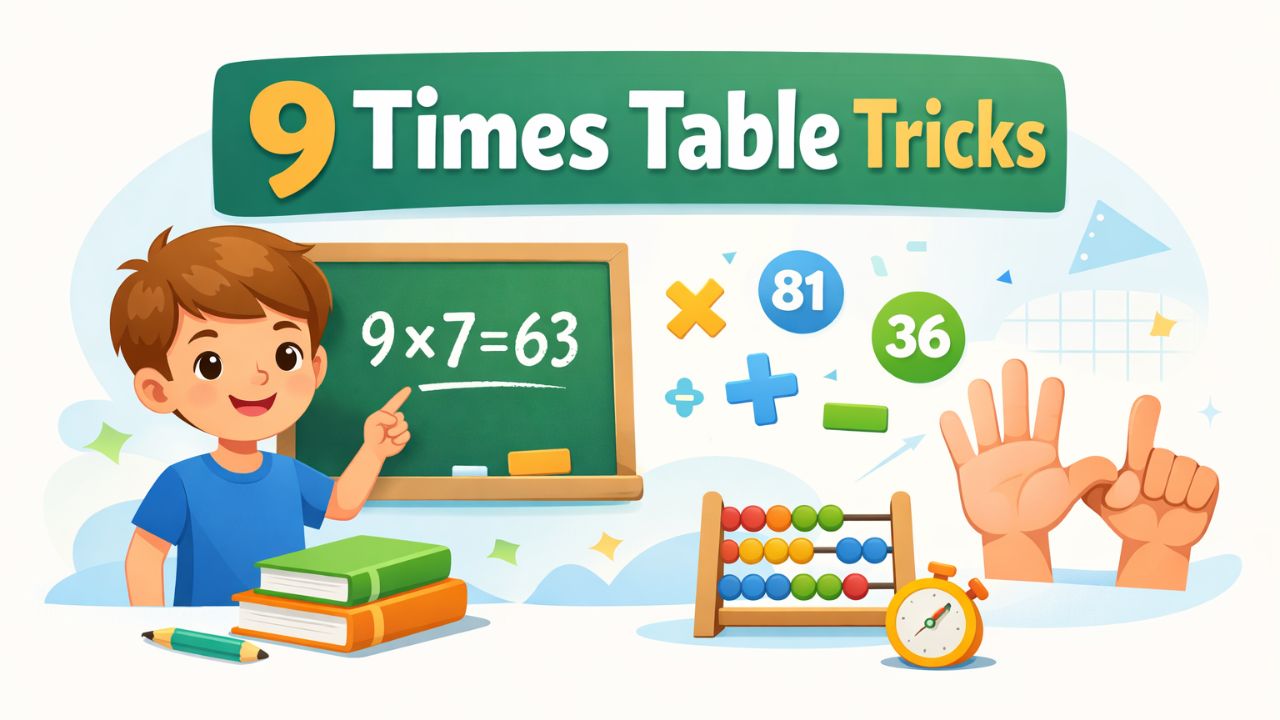
If your child groans when the 9 times table comes up, you’re not alone. It’s one of those tables that looks complicated at first glance, but here’s the secret most people don’t know: the 9 times table is actually one of the most pattern-rich, shortcut-friendly tables in the whole of KS2 maths.
Once children spot those patterns, recall becomes almost automatic.
In this guide, you’ll find step-by-step tricks, memory hacks, common mistakes to avoid, and practice questions — everything needed to help your child go from hesitant to confident. Whether you’re a parent supporting homework, a teacher looking for fresh classroom ideas, or a child wanting to get faster, this article has you covered.
You’ll also discover how to use Hit the Button, the popular interactive maths game, to turn all this practice into real speed and accuracy.
Let’s dive in.
What Is the 9 Times Table?
The 9 times table is simply the number 9 multiplied by each number from 1 to 12 (or beyond).
Here it is in full:
| Multiplication | Answer |
|---|---|
| 1 × 9 | 9 |
| 2 × 9 | 18 |
| 3 × 9 | 27 |
| 4 × 9 | 36 |
| 5 × 9 | 45 |
| 6 × 9 | 54 |
| 7 × 9 | 63 |
| 8 × 9 | 72 |
| 9 × 9 | 81 |
| 10 × 9 | 90 |
| 11 × 9 | 99 |
| 12 × 9 | 108 |
What makes this table special is the beautiful pattern hiding inside every single answer. Once your child sees it, they’ll never forget it.
Why Learning the 9 Times Table Matters
It’s a Core KS2 Requirement
Under the National Curriculum in England, children are expected to know all times tables up to 12 × 12 by the end of Year 4. The Multiplication Tables Check (MTC), taken in Year 4, tests exactly this — under timed conditions.
Being shaky on the 9s can cost valuable seconds and knock confidence at a critical moment.
It Unlocks Harder Maths
The 9 times table feeds directly into:
- Long multiplication
- Division and remainders
- Fractions and percentages
- Problem solving and reasoning questions
A child who knows their 9s instantly doesn’t have to stop and think mid-calculation. That mental bandwidth goes towards the harder part of the problem instead.
It Builds Mathematical Confidence
Research in primary mathematics education consistently shows that fluency in times tables reduces maths anxiety. When a child knows the answer before the question is even finished, they feel capable — and that feeling carries into every other area of maths.
Step-by-Step Guide to Learning the 9 Times Table
Step 1: Learn the Finger Trick
This is the most famous trick for a reason — it actually works, it’s visual, and children aged 6–11 find it genuinely exciting.
How it works:
- Hold both hands out flat in front of you, palms facing down.
- Number your fingers 1–10, left to right.
- To calculate any number × 9, fold down that numbered finger.
- Count the fingers to the left of the folded finger → that’s the tens digit.
- Count the fingers to the right → that’s the units digit.
Example: 7 × 9
Fold down finger number 7 (right index finger).
- Fingers to the left = 6
- Fingers to the right = 3
- Answer = 63 ✓
Mini tip: This works for every multiplication from 1×9 to 10×9. Once children trust it a few times, the visual memory of the finger positions helps even when hands aren’t being used.
Step 2: Spot the Digital Root Pattern
Every answer in the 9 times table has a digit sum of 9.
- 9 → 9
- 18 → 1 + 8 = 9
- 27 → 2 + 7 = 9
- 36 → 3 + 6 = 9
- 45 → 4 + 5 = 9
- 54 → 5 + 4 = 9
- 63 → 6 + 3 = 9
- 72 → 7 + 2 = 9
- 81 → 8 + 1 = 9
- 90 → 9 + 0 = 9
This is incredibly useful for checking answers. If a child multiplies 8 × 9 and gets 74, they can immediately spot the mistake — because 7 + 4 = 11, not 9.
Mini tip: Turn this into a quick game. Call out a number and ask your child: “Could this be in the 9 times table?” They just add the digits to find out.
Step 3: Use the Tens-Minus-One Method
This is the fastest mental strategy for older KS2 children.
The rule: To multiply any number by 9, multiply it by 10 first, then subtract the original number.
Formula: n × 9 = (n × 10) − n
Examples:
- 6 × 9 = (6 × 10) − 6 = 60 − 6 = 54
- 8 × 9 = (8 × 10) − 8 = 80 − 8 = 72
- 12 × 9 = (12 × 10) − 12 = 120 − 12 = 108
Mini tip: This method works for any number, not just 1–12. It’s a mental maths skill that stays useful right through secondary school.
Easy Tricks and Shortcuts for the 9 Times Table
The Descending/Ascending Pattern
Look at the tens and units digits separately:
- Tens digits: 0, 1, 2, 3, 4, 5, 6, 7, 8, 9 → go up by 1
- Units digits: 9, 8, 7, 6, 5, 4, 3, 2, 1, 0 → go down by 1
So the answers write themselves once you spot the sequence:
09, 18, 27, 36, 45, 54, 63, 72, 81, 90
The pattern is symmetrical. The first half mirrors the second half — 09/90, 18/81, 27/72, 36/63, 45/54. This symmetry helps children remember that 9 × 4 and 9 × 5 sit at the centre, with pairs fanning out either side.
The “One Less” Shortcut
For multiplications 1×9 through 9×9:
The tens digit is always one less than the number being multiplied.
- 4 × 9 → tens digit is 3 (one less than 4), units digit makes the sum reach 9, so 36
- 7 × 9 → tens digit is 6 (one less than 7), units digit = 3, so 63
This shortcut alone is enough for most primary school children to recall the 9s rapidly.
Common Mistakes and How to Fix Them
1. Confusing 6 × 9 and 9 × 6
Children sometimes think these are different facts. Remind them that multiplication is commutative — the order doesn’t change the answer. Both equal 54.
2. Getting 7 × 9 and 8 × 9 mixed up
These two trip up children most often. Use the “one less” shortcut: 7 × 9 has a 6 in the tens column (63), and 8 × 9 has a 7 in the tens column (72). Drill these two specifically.
3. Forgetting to subtract in the Tens-Minus-One method
Some children correctly multiply by 10, then forget to subtract. Practise saying the formula out loud: “Times 10, take away the number.”
4. Rushing without checking
Children in timed settings (like the MTC or Hit the Button maths games) sometimes guess rather than use their strategy. Teach them that a one-second check — does the digits add to 9? — is faster than re-doing the whole sum.
5. Stopping at 10 × 9
Many children learn only up to 10 × 9 = 90. The Year 4 curriculum and MTC go up to 12 × 9. Make sure 11 × 9 = 99 and 12 × 9 = 108 are explicitly practised.
6. Confusing 9 × 9 = 81 with 8 × 8 = 64
Square numbers cause interference. A simple rhyme helps: “Nine nines? Eighty-one. Eight eights? Sixty-four.”
7. Weak recall under pressure
Children who know a table slowly often freeze under timed conditions. The fix is short, regular practice in timed bursts — exactly what Hit the Button is designed for.
Fun Practice Methods
At Home
- Shower counting: Call out a 9 times table fact while your child brushes teeth. Alternate who asks and who answers.
- Stair skipping: Each stair = one step in the 9 times table. Say “9, 18, 27…” as you climb.
- Beat the clock: Set a 60-second timer and see how many 9s facts your child can write down correctly. Track progress daily.
In the Classroom
- True or False cards: Show a calculation like “7 × 9 = 65” and have children hold up True/False paddles. Ask them to explain why using the digit sum rule.
- Whiteboard races: Two children at the board. Call a question. First correct answer wins the point. Great for 6 × 9, 7 × 9, and 8 × 9 — the trickiest ones.
- Relay challenge: Each child in a row must answer one 9s fact before passing to the next. Whole team races against the clock.
Real-Life Applications
- “We need 9 packs of pencils. Each pack has 6. How many pencils is that?”
- “9 friends are each bringing 7 stickers to school. How many stickers altogether?”
- Making times tables feel purposeful — not just abstract — deepens memory.
Practise the 9 Times Table Using Hit the Button
One of the most effective tools for building genuine speed is Hit the Button — the interactive maths game used by thousands of primary school children and teachers across the UK.
Here’s why it works so well for times tables:
Speed under pressure: Hit the Button gives children a limited time to answer as many questions as possible. This mirrors the conditions of the MTC and trains the brain to retrieve facts quickly, not just accurately.
Instant feedback: Children immediately see if they’re right or wrong. This rapid feedback loop accelerates learning far faster than worksheet practice alone.
Targeted practice: You can select specific tables — so your child can focus entirely on the 9 times table until those facts are automatic, then move to mixed tables once ready.
Confidence building: Watching their score improve session by session gives children a clear, motivating record of progress. That visible improvement is powerful for reluctant learners.
No login, no fuss: Hit the Button maths is simple to load and start — perfect for a five-minute practice before school or as a classroom warm-up activity.
Try it now — select the 9 times table and see how many you can answer in 60 seconds. Challenge yourself to beat your score each day for one week. Most children see a dramatic improvement by day four or five.
You can also use the Hit the Button game to practise division facts for 9 — the inverse of multiplication — once the multiplication facts feel solid.
Practice Questions
Try these questions. Answers are at the bottom — no peeking!
Straightforward recall:
- 3 × 9 = ?
- 9 × 7 = ?
- 5 × 9 = ?
- 9 × 9 = ?
Slightly trickier: 5. 8 × 9 = ? 6. 9 × 11 = ? 7. 12 × 9 = ?
Mixed challenge: 8. ? × 9 = 54 9. ? × 9 = 72 10. 9 × ? = 36
Word problems: 11. A spider has 8 legs. How many legs do 9 spiders have altogether? 12. There are 9 rows of chairs in a hall. Each row has 7 chairs. How many chairs are there in total?
Answers:
- 27 | 2. 63 | 3. 45 | 4. 81 | 5. 72 | 6. 99 | 7. 108 | 8. 6 | 9. 8 | 10. 4 | 11. 72 | 12. 63
Expert Tips for Parents and Teachers
Keep sessions short and frequent. Five minutes every day beats thirty minutes once a week. The brain consolidates memory through repetition over time, not through cramming.
Focus on the hard three first. In the 9 times table, the facts children struggle with most are 6×9, 7×9, and 8×9. Spend disproportionate time here rather than cycling through the easy ones repeatedly.
Use the digit sum as a self-check habit. Teach children to automatically check their answer by adding the digits. This metacognitive habit — checking your own work — is a broader maths skill that pays dividends across the curriculum.
Don’t skip the inverse. Once multiplication facts are secure, practise division: “63 ÷ 9 = ?” Knowing both directions is what fluency really means, and Hit the Button includes division modes specifically for this.
Praise strategy, not just speed. When a child uses the finger trick or the tens-minus-one method successfully, acknowledge the strategy explicitly: “I love that you used that shortcut — that’s proper mathematical thinking.” This builds a growth mindset around maths.
Link to related tables. The 9 times table connects naturally to the 3 times table and the 6 times table (all multiples of 3). Pointing out these relationships — rather than treating each table as isolated — helps children see maths as a connected system rather than a list of unrelated facts.
Advanced Insight: Why the 9 Times Table Patterns Exist
Most articles just tell you that the patterns exist. Here’s why — and understanding the reason makes the patterns stick even better.
The reason the digits always sum to 9 is connected to the fact that 9 = 10 − 1. Every time you add another 9, you’re adding 10 and subtracting 1. So the tens digit climbs by 1, and the units digit falls by 1 — perfectly and infinitely.
This is also why the “tens minus one” method works. Multiplying by 9 is exactly the same as multiplying by (10 − 1), which by the distributive law of multiplication gives you (n × 10) − (n × 1).
For more advanced KS2 children, this is a beautiful introduction to algebraic thinking — the idea that numbers follow rules, and those rules can be understood, not just memorised.
Children who grasp this tend to generalise well: they start asking “does this work for 8 times table too?” (partially yes — 8 = 10 − 2, so n × 8 = n × 10 − 2n). That kind of curiosity is exactly what strong mathematicians develop.
If your child enjoys spotting these patterns, encourage them to explore the 3 times table, 6 times table, and number bonds to 10 next — all of which share similar underlying structures.
Frequently Asked Questions
What is the easiest trick for the 9 times table? The finger trick is the most beginner-friendly. Hold up 10 fingers, fold down the finger matching the number you’re multiplying by, and count the remaining fingers on each side. It works for 1×9 through 10×9 and requires no memorisation at all to get started.
What age should children know the 9 times table? Under the KS2 National Curriculum in England, children should know all times tables up to 12 × 12 by the end of Year 4 (age 8–9). Most schools introduce the 9 times table in Year 3 or early Year 4.
Is Hit the Button good for practising times tables? Yes — Hit the Button is widely recommended by UK primary teachers because it builds speed and accuracy under gentle time pressure, which mirrors the Year 4 Multiplication Tables Check. It’s free, simple to use, and covers all tables from 2 to 12.
What are the hardest facts in the 9 times table? Most children find 6×9, 7×9, and 8×9 the trickiest. These sit in the “upper middle” of the table where there are no easy anchor points. Focused repetition and the digit-sum self-check help most here.
How long does it take to learn the 9 times table? With five minutes of daily practice, most children achieve reliable recall within two to three weeks. Using a combination of tricks, visual patterns, and a game like Hit the Button accelerates this significantly.
Can the 9 times table tricks help with division too? Absolutely. Once a child knows that 7 × 9 = 63, they automatically know that 63 ÷ 9 = 7 and 63 ÷ 7 = 9. Practising the inverse is an important second step that consolidates both multiplication and division at the same time.
What if my child still struggles after trying these tricks? First, check whether the 2s, 5s, and 10s times tables are fully secure — these are the foundations. If a child is still struggling with the 9s specifically after consistent practice, it may be worth speaking to their class teacher about targeted intervention. Sometimes one-to-one support for a few sessions is all it takes.
Conclusion: From Struggling to Speedy
The 9 times table has a reputation it doesn’t deserve. Once children discover the finger trick, the digit-sum pattern, and the tens-minus-one shortcut, those 12 facts become some of the most accessible in the whole times tables grid.
The key takeaways:
- Spot the patterns — digits always sum to 9, tens go up, units go down
- Use the tricks — finger method for beginners, tens-minus-one for speed
- Check your answers — the digit sum rule is a built-in spell checker
- Practise little and often — five minutes daily beats one long session
- Use Hit the Button — timed practice builds the automatic recall that really counts
Start with the tricks that click for your child, build consistency with short daily sessions, and let the interactive practice on Hit the Button turn that knowledge into genuine speed.
The 9 times table won’t be a problem for long — it’ll become one of their favourites.