
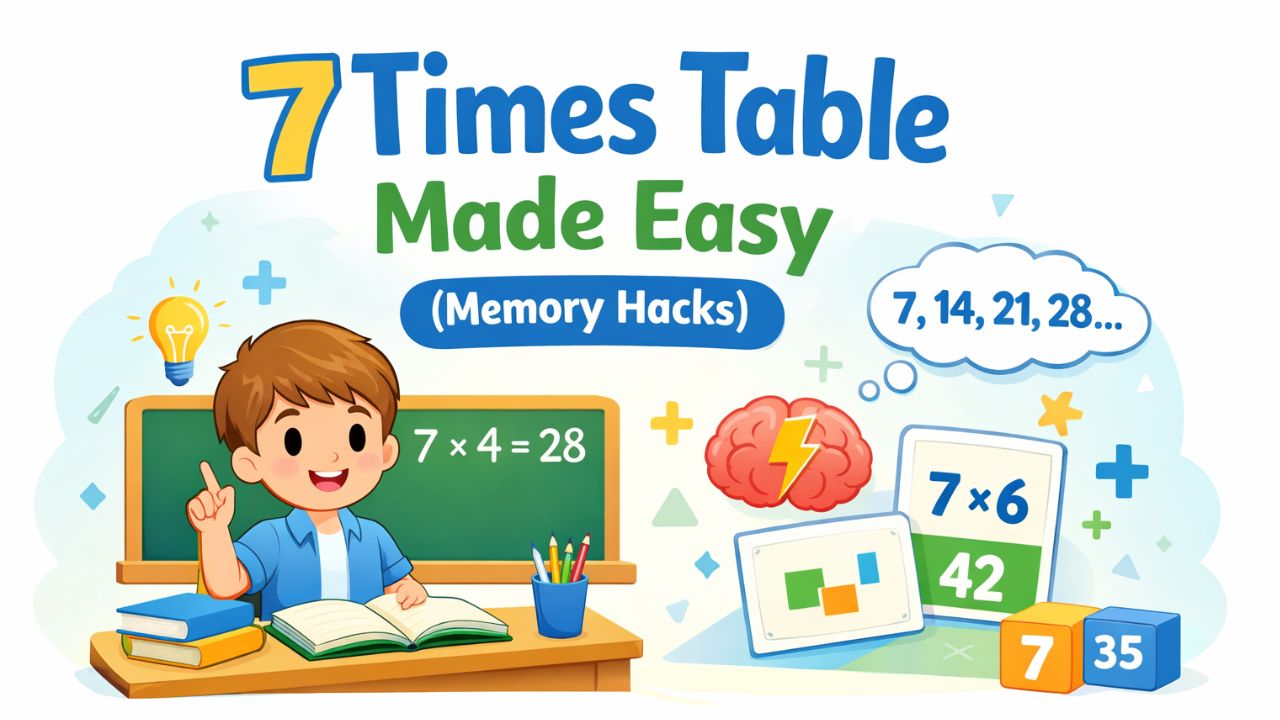
If your child groans when the 7 times table comes up, you’re not alone. The 7s are consistently the trickiest multiplication table for primary school children — and even plenty of adults still count on their fingers for 7 × 8.
But here’s the good news: with the right memory hacks, patterns, and a bit of practice using tools like Hit the Button, the 7 times table goes from the most feared to genuinely manageable. Often in just a week or two.
This guide is written for parents helping at home, teachers looking for fresh classroom ideas, and children who are ready to actually get the 7s once and for all. By the end, you’ll have step-by-step strategies, clever tricks, common mistake fixes, and plenty of practice questions to make it stick.
Let’s get into it.
What Is the 7 Times Table?
The 7 times table is simply the sequence you get when you repeatedly add 7. Each answer is 7 more than the last.
7 × 1 = 7 7 × 2 = 14 7 × 3 = 21 7 × 4 = 28 7 × 5 = 35 7 × 6 = 42 7 × 7 = 49 7 × 8 = 56 7 × 9 = 63 7 × 10 = 70 7 × 11 = 77 7 × 12 = 84
Unlike the 2s, 5s, and 10s — which follow very obvious patterns — the 7s feel more random at first glance. But they’re not. There are real patterns hiding in there, and once children spot them, the table becomes far less frightening.
Why the 7 Times Table Actually Matters
Curriculum Expectations (KS1 & KS2)
Under the UK National Curriculum, children are expected to know all times tables up to 12 × 12 by the end of Year 4. The Multiplication Tables Check (MTC), taken in Year 4, tests recall speed — children have 6 seconds per question.
The 7 times table appears frequently in this check, so fluency isn’t optional. It’s assessed.
Real-Life Uses
Beyond school tests, the 7 times table shows up in:
- Days and weeks — 7 days in a week means multiplying by 7 is genuinely useful (How many days in 6 weeks? 7 × 6 = 42)
- Money — calculating costs in groups of 7
- Cooking and recipes — scaling quantities
- Problem-solving — most word problems at KS2 level involve multiplication
Cognitive Benefits
Learning multiplication tables builds more than just maths skills. Research in mathematics education consistently shows that fluency in times tables:
- Frees up working memory for more complex problem-solving
- Builds mathematical confidence across all areas
- Improves speed and accuracy in mental arithmetic
When a child knows 7 × 8 = 56 automatically, their brain can focus on understanding the bigger maths problem rather than getting stuck on the calculation.
Step-by-Step Guide to Learning the 7 Times Table
Step 1: Start With What You Already Know
Before learning any new facts, remind children what they already know. Many 7 times table facts are simply reverses of tables they’ve already learned.
Examples:
- 7 × 2 = 14 (same as 2 × 7 — from the 2 times table)
- 7 × 3 = 21 (same as 3 × 7 — from the 3 times table)
- 7 × 4 = 28 (same as 4 × 7 — from the 4 times table)
- 7 × 5 = 35 (same as 5 × 7 — from the 5 times table)
- 7 × 10 = 70 (same as 10 × 7 — from the 10 times table)
That’s 5 facts already covered before you’ve even started.
Mini tip: Write out the full table and cross off the ones they already know. Suddenly the list looks much shorter.
Step 2: Learn the Remaining “Tricky Four”
Once the familiar reverses are removed, children really only need to learn four new facts:
- 7 × 6 = 42
- 7 × 7 = 49
- 7 × 8 = 56
- 7 × 9 = 63
That’s it. Four facts. Frame it this way for children and watch the anxiety drop immediately.
Mini tip: Write these four on sticky notes and put them somewhere visible — the fridge, the bathroom mirror, the inside of a pencil case.
Step 3: Build to Automatic Recall
Knowing a fact is different from recalling it instantly. The MTC gives children 6 seconds per question. That means the goal isn’t just understanding — it’s speed.
Build automatic recall through:
- Daily 2-minute drills (oral or written)
- Flashcard practice (mix up the order so it’s not just sequential)
- Online games like Hit the Button where speed matters
Mini tip: Always mix the order of questions. Children who only practise in sequence (7, 14, 21, 28…) often get stuck when questions come in random order — which is exactly how the MTC presents them.
Easy Tricks and Memory Hacks for the 7 Times Table
The Finger Trick for 7 × 8
One of the most memorised maths facts in the primary curriculum:
“5, 6, 7, 8 — 56 = 7 × 8”
Say it like a sequence: 5-6-7-8. The first two digits (56) give you the answer, and the last two (7 × 8) give you the question. Children love this one.
The Odd-Even Units Pattern
Look at the units (last digits) of the 7 times table:
7, 4, 1, 8, 5, 2, 9, 6, 3, 0, 7, 4
The units alternate odd-even-odd-even throughout. While this doesn’t directly give you answers, it helps children check whether their answer is plausible. If 7 × 3 gives them 22, the even units digit should prompt them to double-check.
The Jump Strategy
If a child is stuck between two facts they know, teach them to jump:
Example: Forgotten 7 × 6? Start from 7 × 5 = 35, then add 7. 35 + 7 = 42. Done.
This strategy works in both directions. Know 7 × 7 = 49? Subtract 7 to get 7 × 6 = 42.
Rhymes and Sayings
Some children are auditory learners who remember things they’ve heard. A few popular ones:
- “Seven sevens are forty-nine — seven sevens, feeling fine”
- “Six times seven is forty-two — that’s the answer, through and through”
They’re a bit silly, but that’s exactly why they work. Silly sticks.
The Days-of-the-Week Anchor
Because there are 7 days in a week, the 7 times table has a natural real-world hook. Use it.
Ask children: “If school starts on Monday, what day will it be in exactly 6 weeks?”
7 × 6 = 42 days. Count forward 42 days from Monday — Monday. (Because 42 is divisible into 6 full weeks.) This grounds the maths in something children can picture.
Common Mistakes and How to Fix Them
Mistake 1: Reciting the Table Only in Order
Why it happens: Children practise singing the table from 1 to 12 repeatedly, so the sequence becomes a chain — each answer triggers the next.
Fix: Practise in random order every session. Use flashcards or a game like Hit the Button that presents questions out of sequence.
Mistake 2: Confusing 7 × 6 and 7 × 8
These two facts sit close together and share similar-looking answers (42 and 56). Children regularly mix them up.
Fix: Use the 5-6-7-8 rhyme exclusively for 7 × 8 = 56. For 7 × 6 = 42, try: “Six sevens? That’s 42 — the answer’s waiting there for you.”
Mistake 3: Getting Stuck and Giving Up
Why it happens: The 7s feel hard, so children freeze when they can’t recall an answer immediately.
Fix: Teach the “jump strategy” (Step 2 above). Always having a backup method reduces panic and keeps the brain moving.
Mistake 4: Skipping the Harder Facts
Many children quietly avoid 7 × 7, 7 × 8, and 7 × 9 in practice, gravitating toward the easier ones.
Fix: In any timed practice session, make sure those four tricky facts appear at least twice. Deliberate repetition of the hard ones is how they eventually become easy.
Mistake 5: Learning Without Timed Practice
Why it happens: Children learn the table at a comfortable, slow pace but then panic during the MTC when the 6-second clock is ticking.
Fix: Introduce timed practice early. Hit the Button is ideal for this — it’s designed specifically to build speed alongside accuracy, which is exactly what the MTC requires.
Mistake 6: Not Connecting Multiplication to Division
Children often treat multiplication and division as completely separate. But knowing 7 × 8 = 56 instantly means you also know 56 ÷ 7 = 8 and 56 ÷ 8 = 7.
Fix: After practising multiplication facts, always ask the corresponding division question too.
Mistake 7: Relying on Fingers for Every Answer
Why it happens: It worked for addition, so children default to it.
Fix: Set a rule during practice: no fingers allowed. Fingers slow recall down below the 6-second threshold. The goal is instant retrieval, not calculation.
Fun Practice Methods That Actually Work
At Home
- Fridge magnet challenge: Stick the four tricky facts on the fridge. Every time a child opens it, they have to say one aloud before they’re allowed in.
- 7s at dinner: Ask one 7 times table question per person at the table. Keep it light — wrong answers just mean you try again, no pressure.
- Whiteboard races: Write a question, child answers as fast as possible, wipe and repeat.
In the Classroom
- Call and response: Teacher says “7 times 6” and the class responds together. Great for auditory learners.
- Table tennis drill: Two children face each other. Teacher calls a number; whoever says the correct answer first wins the point.
- Times table bingo: Fill a card with answers from the 7 times table. Teacher calls out multiplication questions; children cross off answers.
Real-Life Applications
- Counting days ahead (7 × number of weeks)
- Sorting items into groups of 7 and counting totals
- Calculating how many items are in 7 packs of something at the supermarket
The more children see 7s in the real world, the faster the table becomes automatic.
Practise the 7 Times Table Using Hit the Button
One of the most effective tools for building times table speed is Hit the Button — an interactive maths game designed specifically for primary school children.
Here’s why it works so well:
Speed training. Hit the Button presents questions quickly and rewards fast responses. This trains the brain to retrieve answers automatically rather than calculating them — exactly the skill needed for the MTC.
Accuracy focus. The game tracks correct and incorrect answers, helping children identify which facts they still need to work on.
Confidence building. As scores improve over repeated sessions, children get visual proof that they’re getting better. That sense of progress is genuinely motivating.
7 times table specific. You can set Hit the Button to focus exclusively on the 7s, which means every minute of play is targeted practice — no time wasted on facts they already know.
Even 5 minutes a day on Hit the Button produces measurable improvement in times table recall within a week or two. Try it after school, during a homework break, or even as a reward for finishing other work.
You can also use Hit the Button for other tables as children progress — it covers all times tables from 2 to 12, as well as number bonds, halving, and doubling.
Practice Questions
Try these yourself — or use them to quiz a child. Answers are at the bottom.
Straightforward recall:
- 7 × 3 = ?
- 7 × 7 = ?
- 7 × 9 = ?
- 7 × 11 = ?
Slightly trickier: 5. 7 × 6 = ? 6. 7 × 8 = ? 7. ? × 7 = 49 8. 56 ÷ 7 = ?
Word problems: 9. A shop sells pencils in packs of 7. How many pencils are in 5 packs? 10. A cinema has 7 rows with 9 seats each. How many seats in total? 11. A farmer plants 7 seeds in each row. He has 8 rows. How many seeds altogether? 12. There are 63 sweets shared equally among 7 children. How many does each child get?
Answers:
- 21 | 2. 49 | 3. 63 | 4. 77 | 5. 42 | 6. 56 | 7. 7 | 8. 8 | 9. 35 | 10. 63 | 11. 56 | 12. 9
Expert Tips for Parents and Teachers
Don’t cram it all in one session. Ten minutes every day beats an hour once a week. Spaced repetition — returning to the same facts over multiple days — is how long-term memory is built.
Praise effort, not just correct answers. “You worked through that really carefully” is more effective than “Well done, you got it right.” It encourages children to keep trying when they don’t get it right immediately.
Use the MTC format for practice. The actual check gives 25 questions in 25 minutes, with 6 seconds per question. Practise in that format — timed, randomised — so the real thing isn’t a shock.
Don’t correct harshly when mistakes happen. If a child gets 7 × 8 wrong, a neutral “Not quite — what do you think 7 × 7 is? Now add 7 to that” works far better than pointing out the error directly.
Track progress visibly. A simple chart on the wall showing weekly best scores gives children something to aim for and helps parents see whether practice is working.
Combine with related skills. Once the 7 times table is solid, connect it to division, factor pairs, and multiplication in column methods. Each connection reinforces the original facts.
Advanced Insight: Why the 7s Feel Hard (And What That Tells Us)
There’s a reason the 7 times table is consistently ranked as the hardest by primary children — and it’s not just about the numbers.
Cognitively, multiplication facts are stored in long-term memory as direct associations: you see “7 × 8” and retrieve “56” as a single unit, rather than calculating it. Psychologists call this fact retrieval and it’s distinct from procedural calculation.
The 2s, 5s, and 10s are learned first and practised most often, so their retrieval pathways are deeply established. The 7s are introduced later, practised less frequently in daily life, and have fewer obvious patterns — so the retrieval pathway takes longer to build.
The solution isn’t more effort — it’s more repetitions with varied cues. Every time a child answers a 7 times table question in a different context (written test, oral drill, game, word problem), they’re strengthening a slightly different pathway to the same answer. Eventually, the answer becomes accessible no matter how the question is presented.
This is exactly why mixing practice methods — drills, games, real-life problems, Hit the Button, oral practice — produces better results than repeating the same method endlessly.
Frequently Asked Questions
What age should children learn the 7 times table? Most children encounter the 7 times table in Year 3 or Year 4 (ages 7–9). The full set of times tables up to 12 × 12 must be known by the end of Year 4 for the Multiplication Tables Check.
How long does it take to learn the 7 times table? With consistent daily practice of 5–10 minutes, most children develop solid recall within 2–4 weeks. The trickiest facts (7 × 6, 7 × 7, 7 × 8, 7 × 9) may take slightly longer.
Is Hit the Button good for learning times tables? Yes — Hit the Button is specifically designed to build speed and accuracy in times table recall. It’s particularly useful for MTC preparation because it mimics the timed format of the actual check.
What is the hardest multiplication fact in the 7 times table? Research and classroom experience consistently point to 7 × 8 = 56 as the most commonly missed. The rhyme “5, 6, 7, 8 — 56 = 7 × 8” is the most reliable trick for locking it in.
Should children learn times tables in order or randomly? Both. Learn the sequence first to understand the pattern. Then practise randomly — out of order, mixed with other tables — to build true automatic recall.
How can I make 7 times table practice less boring? Games are the answer. Hit the Button, bingo, whiteboard races, and oral drills all make practice feel less like a chore. Even 5 minutes of a game beats 20 minutes of reluctant worksheet work.
Do children need to know division facts too? Yes. Multiplication and division are inverse operations. Knowing 7 × 6 = 42 should automatically mean knowing 42 ÷ 7 = 6 and 42 ÷ 6 = 7. Practise both together.
Conclusion
The 7 times table doesn’t have to be the one that trips children up forever. With the right approach — starting from known facts, focusing on just four tricky ones, using memory hacks like the 5-6-7-8 rhyme, and building speed through tools like Hit the Button — children make real progress quickly.
The key is consistency over intensity. A few minutes every day, using a mix of methods, will outperform any single cramming session.
If you take one thing from this guide, let it be this: the 7s aren’t harder because the numbers are harder. They’re harder because they get less practice. Fix that, and the 7 times table becomes just another table your child knows.
Start today. Pick two facts to focus on this week. Play a round of Hit the Button. Ask a question at dinner.
You’ll be surprised how quickly it clicks.
You might also find it helpful to practise number bonds, the 6 times table, or division facts alongside the 7s — each skill reinforces the others and builds overall maths confidence.
