
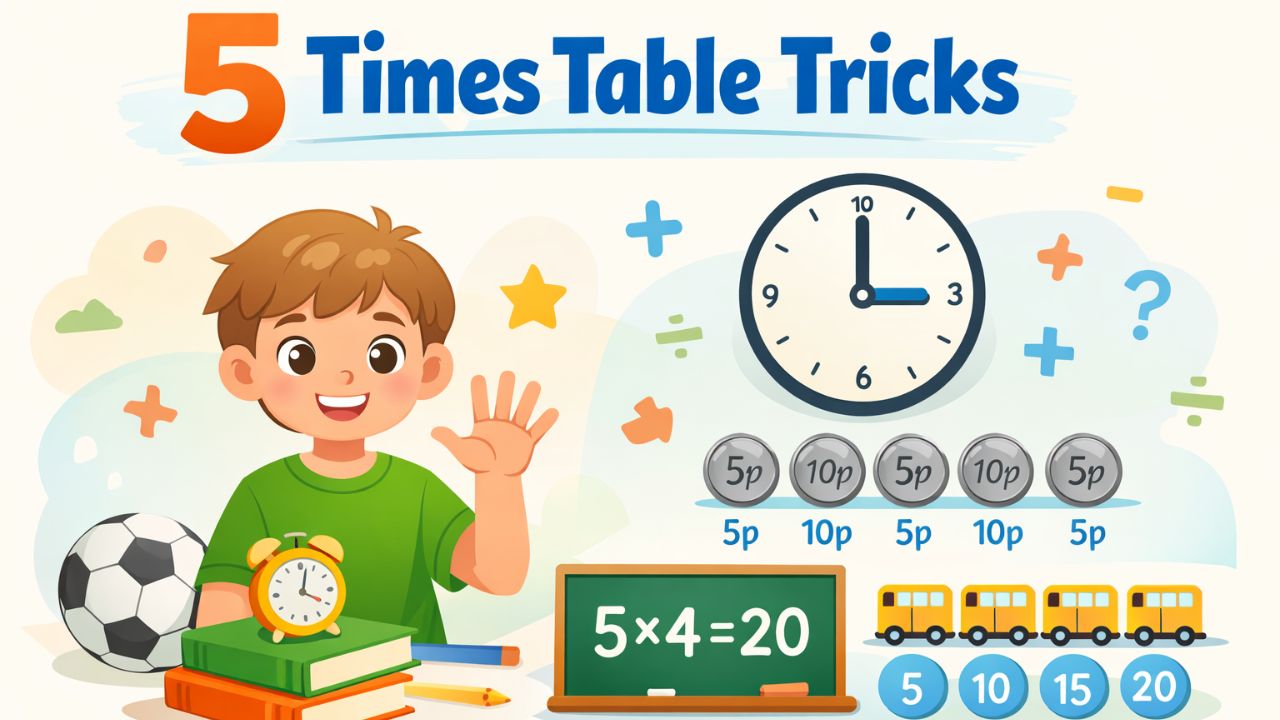
If your child freezes when asked “What’s 7 × 5?” — you’re not alone. The 5 times table is one of the first multiplication tables children tackle in KS1 and KS2, and while it looks simple on paper, many children struggle to recall answers quickly under pressure.
The good news? The 5 times table is packed with patterns that make it one of the easiest to master — once you know how to spot them.
In this guide, you’ll find clear step-by-step explanations, real-life examples your child will actually relate to, memory tricks that stick, and practice questions to build genuine speed and confidence.
Whether you’re a parent helping with homework, a teacher looking for fresh ideas, or a child who wants to get faster at maths — this guide is written for you.
And if you want to practise what you learn right away, our Hit the Button game lets children drill the 5 times table in a fun, pressure-free environment that builds recall speed quickly.
Let’s get started.
What Is the 5 Times Table?
The 5 times table is a set of multiplication facts where you multiply any number by 5. It’s one of the core times tables taught in KS1 and early KS2 — usually introduced around Year 2 and reinforced through Year 4.
Here’s the full table from 1 to 12:
| Multiplication | Answer |
|---|---|
| 1 × 5 | 5 |
| 2 × 5 | 10 |
| 3 × 5 | 15 |
| 4 × 5 | 20 |
| 5 × 5 | 25 |
| 6 × 5 | 30 |
| 7 × 5 | 35 |
| 8 × 5 | 40 |
| 9 × 5 | 45 |
| 10 × 5 | 50 |
| 11 × 5 | 55 |
| 12 × 5 | 60 |
Notice anything? Every single answer ends in either a 5 or a 0. That’s the golden rule of the 5 times table — and it’s the first trick children should learn.
Why Knowing the 5 Times Table Really Matters
It’s easy to think of times tables as just something you memorise for a test. But the 5 times table shows up constantly in everyday life — and building fluency with it gives children a real advantage in maths and beyond.
In school (KS1 & KS2): The National Curriculum expects children to recall multiplication facts up to 12 × 12 by the end of Year 4. The 5 times table is a foundation. Children who know it confidently find division, fractions, and mental arithmetic significantly easier.
In real life:
- Counting money (5p coins, £5 notes)
- Reading a clock (each number represents 5 minutes)
- Cooking measurements, grouping objects, counting in sport
For the brain: Repeated recall of multiplication facts builds what educators call automaticity — the ability to retrieve information without thinking hard about it. This frees up mental energy for harder problems. A child who has to work out 7 × 5 each time is using brainpower that should be solving the bigger problem.
Step-by-Step Guide to Learning the 5 Times Table
Step 1: Start With Counting in 5s
Before memorising facts, children should be comfortable counting in 5s. This builds the mental number line they’ll rely on.
Count aloud: 5, 10, 15, 20, 25, 30, 35, 40, 45, 50, 55, 60
Real-life example: Ask your child to count the fingers on two hands — 5 fingers per hand. Three children = 15 fingers. Five children = 25 fingers. This makes multiplication physical and visual.
Mini tip: Clap or tap on each number while counting. The rhythm helps the sequence stick in memory.
Step 2: Spot the Pattern (0s and 5s)
Now that your child can count in 5s, draw their attention to the pattern: every answer ends in 0 or 5, alternating throughout the table.
- Odd multiples (1×5, 3×5, 5×5…) end in 5
- Even multiples (2×5, 4×5, 6×5…) end in 0
Real-life example: Think about a clock face. The minute hand points to 1 — that’s 5 minutes. Points to 2 — that’s 10 minutes. Points to 7 — that’s 35 minutes. The clock is literally the 5 times table on the wall.
Mini tip: If your child gets a 5 times table answer that ends in anything other than 0 or 5, they know immediately it’s wrong. This is a built-in self-checking tool.
Step 3: Connect to Known Facts
Children often know more than they think. Use what they already know to build new knowledge.
- They know 10 × 5 = 50 (ten 5s)
- So 9 × 5 must be one less 5: 50 − 5 = 45
- And 11 × 5 must be one more 5: 50 + 5 = 55
Real-life example: If five apples cost 10p each — wait, that’s 10 × 5 = 50p. If you only buy 9 apples, take away 5p: that’s 45p.
Mini tip: Teach children to use 10 × 5 as an anchor fact. From there, they can reach any fact in the table by adding or subtracting 5.
Easy Tricks and Shortcuts for the 5 Times Table
The Clock Trick
Every number on a clock represents 5 minutes. When a child reads the clock, they’re using the 5 times table without realising it.
Ask: “The minute hand is on the 8 — how many minutes is that?” Answer: 8 × 5 = 40 minutes.
This turns every clock in the house into a maths tool.
The Half-of-10 Trick
Multiplying by 5 is the same as multiplying by 10 and then halving.
- 6 × 5 → 6 × 10 = 60 → half of 60 = 30 ✓
- 14 × 5 → 14 × 10 = 140 → half of 140 = 70 ✓
This trick is especially powerful for older KS2 children who need to extend beyond the 12 times table.
The Finger Skip-Count Method
Hold up both hands. Each finger represents one jump of 5. Count across your fingers to find any answer up to 10 × 5.
Younger children in KS1 find this enormously helpful — it gives them a physical method before they’ve built mental fluency.
The “Always Ends in 0 or 5” Check
Teach this as a rule, not just a pattern: if a child multiplies any whole number by 5 and the answer doesn’t end in 0 or 5, the answer is wrong. Full stop.
This simple rule catches errors instantly and builds mathematical confidence.
Common Mistakes Children Make (and How to Fix Them)
Mistake 1: Confusing 5 × and + 5
Children sometimes add 5 instead of multiplying by 5.
Fix: Use physical groups. “5 × 3 means THREE groups of 5.” Lay out three groups of five counters to make the distinction concrete.
Mistake 2: Forgetting the Pattern After 10 × 5
Many children memorise up to 10 × 5 confidently, then stumble on 11 × 5 and 12 × 5.
Fix: Teach 11 × 5 = 55 and 12 × 5 = 60 separately as “bonus facts.” Use the rhyme: “Eleven fives are fifty-five, twelve fives make sixty, watch them thrive.”
Mistake 3: Slow Recall Under Pressure
Children who know the table but take too long are likely recounting from 5 each time rather than recalling directly.
Fix: Use timed games like Hit the Button to practise rapid recall. Speed comes from repeated retrieval, not repeated counting.
Mistake 4: Mixing Up 6 × 5 and 7 × 5
These two facts (30 and 35) are the most commonly confused.
Fix: Use a memory link: “Six times five — I’m alive — thirty!” Then “Seven times five — thirty-FIVE — jive!” The rhyming sticks.
Mistake 5: Reversing the Multiplication
Some children think 5 × 7 and 7 × 5 give different answers.
Fix: Demonstrate with objects. Five groups of seven equals seven groups of five — both equal 35. This is the commutative law, and it halves the number of facts children need to learn.
Mistake 6: Skipping Odd Multiples
Children often feel more confident with even multiples (10, 20, 30) and hesitate on odd ones (5, 15, 25, 35).
Fix: Drill odd multiples separately. Ask: “What’s 3 × 5? 5 × 5? 7 × 5? 9 × 5?” Give extra praise for speed on these.
Mistake 7: Not Checking Their Answer
Children rarely self-check multiplication answers.
Fix: Teach the 0-or-5 rule as a habit: “Always look at the last digit. If it’s not 0 or 5, try again.”
Fun Practice Methods
At Home
Coin counting: Give your child a pile of 5p coins. Ask them to count up to different amounts. “How many 5ps make 35p?” This is 7 × 5 in disguise.
Stair counting: Count 5 for each step as you go up the stairs. By step 12, you’ve covered the whole table.
TV time: During ad breaks, fire quick questions. Keep a tally of correct answers — children love seeing their score grow.
In the Classroom
Times table volleyball: Teacher calls a number, child multiplies by 5 and “passes” by calling on a classmate to go next.
Whiteboard races: Two children stand at whiteboards. Teacher calls “8 × 5” — first to write the correct answer wins.
Clock maths: Use a large paper clock. Teacher moves the hands, children call out the minutes (they’re using 5 times table facts without realising).
Real-Life Connections
- Shopping with 5p coins
- Counting seats in rows of 5
- Measuring time in 5-minute intervals
- Scoring in groups of 5 in sports
The more contexts children see the 5 times table in, the more naturally it embeds.
Practise Using Hit the Button
One of the fastest ways to build real recall speed is through timed, repeated practice — and that’s exactly what Hit the Button is designed for.
Hit the Button is an interactive maths game that challenges children to answer multiplication questions as quickly as possible. You select the times table — in this case, ×5 — and the game fires questions at speed, awarding points for accuracy and pace.
Why Hit the Button works so well for the 5 times table:
- Speed: The timed format forces children to recall, not calculate — which is exactly the habit that builds automaticity
- Accuracy: Immediate feedback means children correct mistakes in the moment, not days later
- Confidence: Watching your score improve across sessions is genuinely motivating for children aged 6–11
- Flexibility: You can switch between multiplication and division facts for the same table — great for extending practice
Even five minutes of Hit the Button a day, three or four times a week, can make a measurable difference in recall speed within two to three weeks.
Try selecting just the ×5 table first. Once your child hits consistent scores, challenge them to mix the 5s with the 2s or 10s — a great way to extend without overwhelming.
Practice Questions
Try these questions. Answers are listed at the bottom.
Beginner:
- 2 × 5 = ?
- 5 × 5 = ?
- 1 × 5 = ?
- 10 × 5 = ?
Intermediate: 5. 7 × 5 = ? 6. 9 × 5 = ? 7. 6 × 5 = ? 8. 4 × 5 = ?
Challenge: 9. 11 × 5 = ? 10. 12 × 5 = ? 11. If 5 children each have 8 stickers, how many stickers altogether? 12. A shop sells pens in packs of 5. You buy 7 packs. How many pens?
Answers:
- 10 | 2. 25 | 3. 5 | 4. 50 | 5. 35 | 6. 45 | 7. 30 | 8. 20 | 9. 55 | 10. 60 | 11. 40 | 12. 35
Expert Tips for Parents and Teachers
Practise little and often. Five minutes daily beats one long session weekly. Short, frequent retrieval is how long-term memory is built.
Say it out loud. Verbal recall is faster to build than written recall. Encourage children to say answers aloud, not just think them.
Celebrate the process, not just the answer. “I love how quickly you checked yourself” is more powerful than “well done, you got it right.”
Don’t rush to the next table. Some children are pushed to move on before the 5 times table is fully secure. A child who can recall every fact in under two seconds is ready to move on — not before.
Use the inverse. Once multiplication facts are solid, introduce division: “If 35 ÷ 5 = ?” This doubles the learning value of every fact and prepares children for the KS2 multiplication check and beyond.
Make mistakes safe. Children who fear getting it wrong recall slower because anxiety interferes with memory retrieval. Keep the environment low-pressure, especially with timed activities.
Advanced Insight: Why the 5 Times Table Is a Gateway Skill
Most guides stop at tricks and practice. But there’s something deeper worth understanding about why the 5 times table is so important developmentally.
The 5 times table is one of the first places children encounter multiplicative thinking — the shift from seeing numbers as things you add to things you scale. A child who understands that 6 × 5 means “six groups of five” has made a conceptual leap that underpins fractions, percentages, and algebra.
Interestingly, researchers in mathematics education have found that children who master the 5 and 2 times tables early tend to develop better number sense overall — because both tables make the underlying structure of our base-10 number system visible.
When a child sees that 7 × 5 = 35 and half of 70 = 35, they’re not just learning a fact — they’re building an intuition about how numbers relate to each other. That intuition is what separates a child who “knows their tables” from one who genuinely understands multiplication.
This is also why games like Hit the Button are more effective than flashcards alone. Retrieval practice in a varied, unpredictable order (as games provide) builds stronger memory traces than drilling in sequence.
FAQ: 5 Times Table
Q: At what age should children know the 5 times table? Most children are introduced to it in Year 2 (ages 6–7) and expected to recall all facts confidently by the end of Year 4 (ages 8–9), in line with the KS2 National Curriculum expectations.
Q: What’s the fastest trick for learning 5 times table? The half-of-10 trick: multiply by 10, then halve the answer. It works for any number and is quicker than counting up in 5s once children know how to halve confidently.
Q: How is Hit the Button helpful for times tables? Hit the Button provides timed, randomised retrieval practice — the most effective method for building automatic recall. It covers multiplication and division facts, including the full 5 times table, and gives immediate feedback on every answer.
Q: Why does my child know the table in order but can’t answer random questions? This is very common. Knowing facts in sequence uses a different memory process than random retrieval. Games and mixed drilling fix this — sequence memory and random recall need to be practised separately.
Q: Should I use multiplication or division practice for the 5 times table? Both. Once the multiplication facts are secure, division practice (e.g., 45 ÷ 5 = ?) reinforces the same facts from a different angle and prepares children for related maths skills.
Q: Is the 5 times table part of the Year 4 Multiplication Tables Check (MTC)? Yes. The MTC tests all tables from 2 to 12, including the 5 times table, under timed conditions. Children are expected to answer in around 6 seconds per question, making speed of recall essential.
Q: What should I do if my child finds the 5 times table too easy? Extend with larger numbers (13 × 5, 20 × 5), introduce division, or mix the 5s with other tables they’re learning. You can also connect to fractions — “what is ½ of 5?” builds the same multiplicative thinking.
Conclusion: Build the Habit, Watch the Confidence Grow
The 5 times table is more than just a list of facts. It’s a window into how multiplication works, a daily tool for reading time and handling money, and a foundation for almost every maths skill that comes after it.
The children who master it aren’t always the ones who were “good at maths” naturally — they’re the ones who practised in short, regular bursts and used the right tools.
Use the clock trick. Use the half-of-10 method. Point out the 0-and-5 pattern every time it comes up. And when your child is ready to test themselves under pressure, let them play a few rounds of Hit the Button — it’s the closest thing to a proper workout for multiplication recall.
Keep it consistent, keep it low-pressure, and the confidence will follow.
You can also practise number bonds, addition facts, and other times tables on the site — each one builds on the last, and the more your child sees the connections between them, the stronger their overall maths foundation becomes.
