
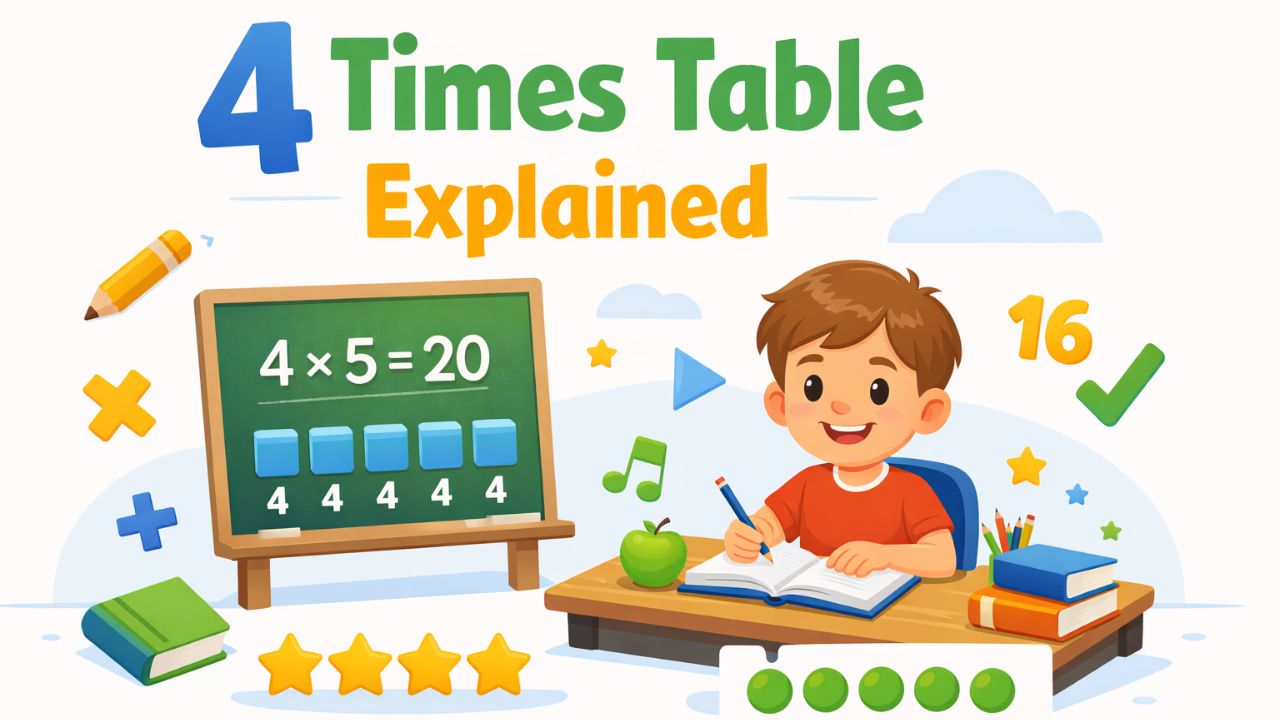
If your child is starting to learn multiplication, the 4 times table is one of the most important milestones in their maths journey. It builds directly on skills they already have — and once it clicks, it opens the door to faster mental maths, stronger problem-solving, and real confidence in the classroom.
Whether you’re a parent supporting homework, a teacher planning a lesson, or a child ready to give it a go — this guide walks through everything step by step.
You’ll find clear explanations, easy memory tricks, common mistakes to avoid, and plenty of practice questions to test what you’ve learned. We’ve also included a section on how to use Hit the Button — an interactive maths game — to make practising the 4 times table fast, fun, and effective.
By the end of this page, your child will understand the 4 times table inside out and know exactly how to practise it until it becomes second nature.
Let’s get started.
What Is the 4 Times Table?
The 4 times table is a list of multiplication facts where one number is always 4. Multiplying means adding the same number again and again — so the 4 times table is simply counting in fours.
Here’s the full 4 times table:
| Multiplication | Answer |
|---|---|
| 1 × 4 | 4 |
| 2 × 4 | 8 |
| 3 × 4 | 12 |
| 4 × 4 | 16 |
| 5 × 4 | 20 |
| 6 × 4 | 24 |
| 7 × 4 | 28 |
| 8 × 4 | 32 |
| 9 × 4 | 36 |
| 10 × 4 | 40 |
| 11 × 4 | 44 |
| 12 × 4 | 48 |
Think of it this way: if you had 4 bags and each bag had 3 apples, you’d have 3 × 4 = 12 apples in total. Simple!
Why the 4 Times Table Matters
At School (KS1 and KS2)
In England, children are expected to know their multiplication tables up to 12 × 12 by the end of Year 4. The 4 times table is usually introduced in Year 2 or Year 3, and it appears across many areas of maths:
- Division (the inverse of multiplication)
- Fractions (finding quarters involves dividing by 4)
- Area and perimeter calculations
- Problem-solving word problems
The Multiplication Tables Check (MTC) — a government test taken in Year 4 — includes questions from all times tables, including the 4s. Children are given just 6 seconds per answer, so speed matters.
In Real Life
The 4 times table comes up more often than you’d think:
- Counting legs on animals (4 legs × 3 dogs = 12 legs)
- Working out how many wheels on cars (4 wheels × 5 cars = 20 wheels)
- Grouping items in sets of 4 for games, sports, or packaging
For the Brain
Learning times tables isn’t just about maths — it builds working memory, improves number sense, and frees up mental energy for harder problems. When multiplication becomes automatic, children can focus on understanding the bigger picture instead of counting on their fingers.
Step-by-Step Guide to Learning the 4 Times Table
Step 1 — Start by Counting in Fours
Before memorising facts, children should feel comfortable skip-counting in 4s. This builds the pattern in their mind first.
Count out loud: 4, 8, 12, 16, 20, 24, 28, 32, 36, 40, 44, 48
Try this: point to each number as you say it. Do it forwards, then backwards. Backwards is harder — but it really cements the sequence.
Mini tip: Clap or tap the table as you count. Rhythm helps the brain hold sequences in memory.
Step 2 — Use the “Double Double” Method
Here’s a secret that makes the 4 times table much easier: 4 is just 2 doubled.
So instead of trying to remember 7 × 4, you can do this:
- 7 × 2 = 14
- Double it: 14 × 2 = 28
- So 7 × 4 = 28 ✓
Most children already know the 2 times table, so this gives them a shortcut they can trust every time.
Example:
- 9 × 4 → 9 × 2 = 18 → 18 × 2 = 36 ✓
- 6 × 4 → 6 × 2 = 12 → 12 × 2 = 24 ✓
Mini tip: Practise this with a few numbers until it feels quick. It’s a reliable strategy that never fails.
Step 3 — Memorise the Trickiest Facts
Some multiplication facts are harder to remember than others. For the 4 times table, these tend to trip children up most often:
- 7 × 4 = 28 — Use: “7 ate (8) 2 fours… 28!”
- 8 × 4 = 32 — Use: “8 fours, 32 floors”
- 9 × 4 = 36 — Use: Double 18
Make flashcards for these three. Cover the answer and see if you can recall it in under 3 seconds.
Mini tip: Learn the ones you find hardest first. Don’t just practise the easy ones — that’s where most children waste time.
Easy Tricks and Shortcuts
The Even Number Rule
Every answer in the 4 times table is an even number. If you ever get an odd answer, you’ve made a mistake. This is a great self-checking tool during tests.
The Last Digit Pattern
Look at the last digit of each answer in the 4 times table: 4, 8, 12, 16, 20, 24, 28, 32, 36, 40, 44, 48
The last digits repeat in this pattern: 4, 8, 2, 6, 0 — then it loops again. So if you know 3 × 4 = 12, then 8 × 4 must end in 2… and it does: 32.
The Hand Trick for ×5 and ×4
If your child knows 5 × 4 = 20, they can work backwards:
- 4 × 4 = 20 − 4 = 16
- 6 × 4 = 20 + 4 = 24
Use any known fact as a stepping stone.
Common Mistakes and How to Fix Them
1. Confusing the 4 and 3 times tables This is very common. Children mix up 3 × 4 = 12 and 4 × 4 = 16. Fix: Practise them separately before mixing them. Use colour-coded flashcards — one colour per table.
2. Forgetting that multiplication is commutative Children often think 4 × 7 and 7 × 4 are different problems. Fix: Explain with objects: “4 groups of 7 or 7 groups of 4 — the total is always 28.”
3. Stopping the count at 10 × 4 Many children don’t practise 11 × 4 and 12 × 4 enough. Fix: Include 11 and 12 in every practice session, not just as an afterthought.
4. Rushing and making careless errors Under time pressure (like the MTC), children skip-count too fast and lose track. Fix: Use timed practice in short bursts — 60 seconds of questions per session. Hit the Button maths game is ideal for this.
5. Relying on fingers Some children count up in 4s on their fingers each time. Fix: Gradually replace finger-counting with recall. Start with just 3–4 facts to memorise, then build up.
6. Not linking multiplication to division Children who don’t see the relationship between multiplication and division struggle later. Fix: After learning 4 × 6 = 24, immediately ask: “So what is 24 ÷ 4?”
7. Only practising in order Reciting the table in order doesn’t mean a child knows their facts randomly — which is what real tests require. Fix: Use flashcards, apps, and games that ask questions out of order.
Fun Ways to Practise at Home and in Class
At Home
- Kitchen maths: “We need 4 plates for dinner — how many pieces of cutlery is that if everyone gets 4 pieces?”
- Flashcard games: Shuffle a set of cards and race against the clock.
- Times table songs: Search for 4 times table songs on YouTube — music is a powerful memory tool.
- Beat your score: Write 12 questions on paper, set a 60-second timer, and try to beat yesterday’s score.
In the Classroom
- Four corners: Each corner of the room is labelled with a number. Teacher calls out a multiplication — children move to the corner with the correct answer.
- Buzz game: Count around the class in 4s — whenever a multiple of 4 appears, say “Buzz!” instead.
- Mini whiteboards: Teacher calls out a fact, children write the answer and hold it up simultaneously.
Real-Life Applications
- Counting chairs in rows of 4
- Grouping LEGO bricks into sets of 4
- Working out how many wheels on a given number of cars or bikes
Practise with Hit the Button
One of the most effective tools for building times table speed is Hit the Button — a popular online maths game used in thousands of UK primary schools.
How it works: A multiplication question appears on screen. You hit the correct answer button as quickly as possible. Sounds simple — but under time pressure, it trains your brain to recall facts instantly rather than working them out slowly.
Why Hit the Button works for the 4 times table:
- Speed: Answering against the clock builds automaticity — so facts pop into your head without effort
- Accuracy: Immediate right/wrong feedback means children learn from mistakes in real time
- Confidence: Watching your score improve session after session is genuinely motivating
- Flexibility: You can focus specifically on the 4 times table, or mix tables to challenge yourself further
Hit the Button maths is particularly useful for Year 3 and Year 4 children preparing for the Multiplication Tables Check. Using it for just 5–10 minutes a day — consistently — produces measurable improvement within two to three weeks.
The Hit the Button times tables mode lets children select exactly which table they want to practise. Start with 1–6 × 4, then push to 1–12 × 4 as confidence grows.
Whether your child calls it “hit the button,” “hit the botton,” or “press the button maths” — the game is the same, and it genuinely works.
Practice Questions
Try these on paper before checking the answers. Mix them up — don’t go in order.
- 3 × 4 = ?
- 7 × 4 = ?
- 11 × 4 = ?
- 4 × 4 = ?
- 9 × 4 = ?
- 6 × 4 = ?
- 12 × 4 = ?
- 5 × 4 = ?
- 8 × 4 = ?
- 2 × 4 = ?
- 36 ÷ 4 = ?
- 48 ÷ 4 = ?
Answers:
- 12 | 2. 28 | 3. 44 | 4. 16 | 5. 36 | 6. 24 | 7. 48 | 8. 20 | 9. 32 | 10. 8 | 11. 9 | 12. 12
Expert Tips for Parents and Teachers
Keep sessions short and frequent. Five minutes daily beats one 30-minute session per week. The brain learns through spaced repetition — coming back to the same facts over multiple days cements them far more effectively.
Praise effort, not just correct answers. When a child gets 7 × 4 wrong but tries using the double-double method, praise the strategy. This builds a growth mindset around maths.
Mix it up. Don’t always practise in the same way. Alternate between written questions, verbal quizzing, flashcards, and digital games like Hit the Button. Variety keeps the brain engaged.
Link to division immediately. Once children know 4 × 8 = 32, introduce 32 ÷ 4 = 8 and 32 ÷ 8 = 4. Understanding the relationship between multiplication and division is a KS2 requirement and saves time in the long run.
Identify the gap facts. Ask your child to go through the 4 times table and mark which facts they’re unsure of. Focus practice time on just those facts — don’t waste energy on facts they already know well.
Use real objects first. For younger learners (Year 2), physically grouping objects into sets of 4 before working abstractly helps build genuine understanding rather than just rote recall.
Advanced Insight: Why Automaticity Changes Everything
There’s a concept in cognitive science called cognitive load — the mental effort required to complete a task. When a child has to work out 6 × 4 from scratch every time, it uses up working memory that should be reserved for understanding the actual problem.
Once times table facts become automatic — meaning they’re recalled without conscious effort — children free up mental space for higher-order thinking: reasoning, estimation, multi-step problems, and eventually algebra.
Research in mathematics education consistently shows that children who achieve automaticity with multiplication facts by the end of Year 4 are significantly better prepared for KS3 maths. The 4 times table, alongside the 2s and 8s, forms a particularly important cluster because they’re all connected through doubling — making them efficient to learn together.
This is why tools like Hit the Button are so effective: they specifically target the gap between “knowing the answer slowly” and “knowing the answer instantly.” That gap matters enormously in classroom tests and real-life maths.
If your child is working on the 4 times table, also consider introducing the 8 times table soon after — since 8 is simply 4 doubled, the patterns reinforce each other naturally.
You might also explore number bonds, the 2 times table, or division facts as natural next steps.
Frequently Asked Questions
What age should children learn the 4 times table? Most children are introduced to the 4 times table in Year 2 or Year 3 (ages 6–8), and are expected to know it confidently by the end of Year 4. That said, every child learns at a different pace, and earlier exposure is always beneficial.
What is Hit the Button and how does it help? Hit the Button is a free online maths game widely used in UK primary schools. It presents multiplication (and other maths) questions in a timed format, helping children build speed and accuracy. It’s particularly effective for times tables practice and is suitable for KS1 and KS2 learners.
How long does it take to learn the 4 times table? With daily practice of 5–10 minutes, most children can recall the 4 times table confidently within 2–4 weeks. Consistency matters far more than the length of individual sessions.
What if my child keeps forgetting 7 × 4 and 8 × 4? These are the most commonly forgotten facts across all times tables. Focus specifically on these two: use the double-double method (double 7 to get 14, double again to get 28) and create a dedicated flashcard. Review these facts every single day until they stick.
Is the 4 times table in the Multiplication Tables Check? Yes. The Year 4 MTC includes questions from all tables up to 12. Children have 25 questions and 6 seconds per answer. Practising with Hit the Button replicates this time pressure effectively.
How does the 4 times table connect to fractions? Finding a quarter of a number means dividing by 4. So knowing the 4 times table helps children calculate quarters quickly — for example, a quarter of 32 is 8 because 8 × 4 = 32.
Can the 4 times table help with the 8 times table? Absolutely. The 8 times table is simply the 4 times table doubled. If your child knows 6 × 4 = 24, then 6 × 8 = 48. Learning them together is an efficient strategy.
Conclusion
The 4 times table is one of those skills that — once mastered — quietly makes everything else in maths easier. From fractions to division to mental arithmetic, knowing your 4s gives children a real advantage.
The key takeaways from this guide:
- Count in 4s first to build the pattern
- Use the double-double method as a reliable shortcut
- Focus extra practice on the tricky facts (7 × 4, 8 × 4, 9 × 4)
- Practise out of order, not just reciting the table in sequence
- Keep sessions short, consistent, and varied
Most importantly — keep going. Every child who practises regularly gets there. There’s no shortcut to consistency, but the results are absolutely worth it.
Use Hit the Button regularly to build the speed and accuracy your child needs for the MTC and beyond. Even five minutes a day makes a real difference over time.
Good luck — you’ve got this!
